
Assume a client matches the US model's 20 seats at $225 a month. Monthly recurring revenue, or MRR, is 20 times $225, giving $4,500. Put that calculation on your account review template beside the actual delivery cost, rather than treating the fee as evidence that the account is healthy.
For this hypothetical client, calculate the delivery-cost allowance as MRR times one minus the model's 50% managed-service gross margin target: $4,500 × (1 − 50%) = $2,250. That allowance includes burdened delivery labor and tools. It isn't a measured cost for this hypothetical client; substitute the actual matched-period costs before deciding what to do.
Build the Page Around a Decision
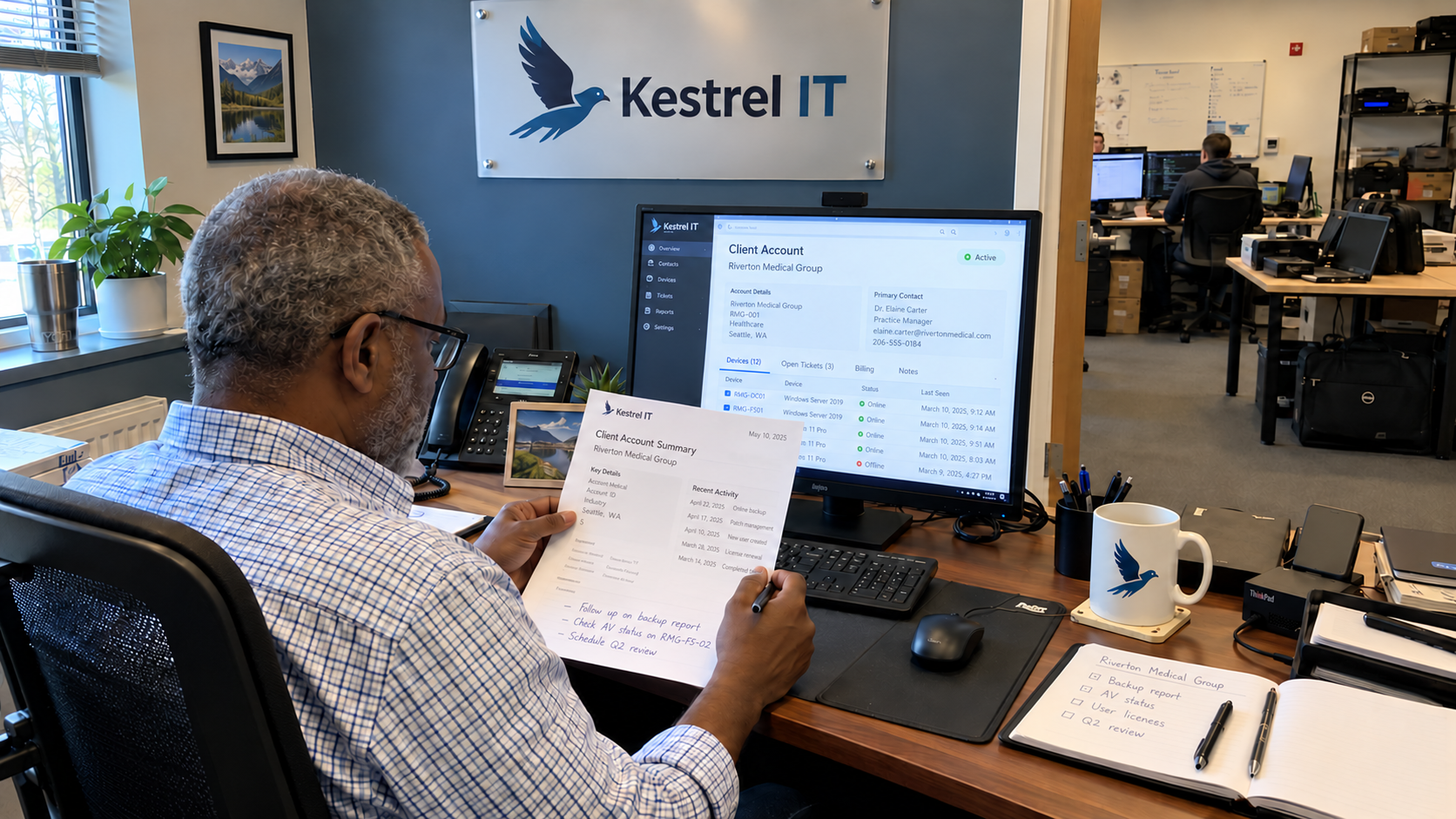
The model calls for a quarterly review of every client's margin and fit. Keep a dated page for each account so the owner can compare its current position with the previous review. Use the page to explain the next decision rather than compressing the whole client record into smaller type.
Put the client name and review period at the top, with the person responsible for checking the figures. Reference the source records behind the calculations. A result without a period or an accountable preparer is hard to challenge and harder to repeat.
I'd use the following fields as the main page, with the decision recorded underneath. Keep commercial values on a consistent basis so a hardware sale doesn't appear to improve the recurring service margin.
| Signal | What the Page Shows | What It Helps You Decide |
|---|---|---|
| Seats | Current billable seats, recurring managed fee, and calculated fee per seat | Whether the billed scope and the work supported still agree |
| Managed-service margin | Matched revenue and fully loaded delivery cost, with the resulting gross profit and margin | Whether a price or delivery-cost problem needs action |
| Ticket load | Relevant tickets and seats for the same period, with the work behind a material change | Whether demand or effort needs investigation |
| Contract decision window | Renewal and non-renewal notice dates taken from the actual agreement | When the owner must prepare the account decision and conversation |
The page should finish with the next action and its named owner, plus the date on which the owner will inspect the result. Refer to the separate client plan for detailed work. A row labelled 'monitor' doesn't say what anyone has agreed to change.
Check the Seat and Fee Basis First
Use the agreed billable-seat definition and confirm the current count against the supported scope. For the model example, $4,500 divided by 20 seats is $225 per seat. If either input is wrong, the result changes even when the spreadsheet formula is correct.
Keep recurring product resale and project work separate from the managed service being assessed. Record a disputed billing change as unresolved rather than silently substituting the amount you expect to collect. The review needs a consistent basis before it can show a trend.
If the count changed during the period, explain that change beside the revenue comparison. A larger fee with more supported seats isn't automatically evidence of better pricing. Reconcile what changed before drawing that conclusion.
Use Fully Loaded Delivery Cost for the Margin
Gross profit is managed-service revenue less the delivery cost attributed to that service. Gross margin is that gross profit divided by the same revenue. Use burdened pay for delivery labor, including the account work the service actually consumes. Burdened pay includes salary and the associated employer costs.
Include tools and the relevant share of shared delivery work, using a documented allocation method. Check the basis stays consistent between accounts. Changing the allocation between reviews can move a client's margin without changing the work or price.
In the hypothetical at the target allowance, $4,500 less $2,250 is $2,250 gross profit; $2,250 divided by $4,500 is 50%. If measured delivery cost is higher than the allowance, the account misses that target. It can still contribute while its gross profit remains positive, so a target miss isn't an automatic instruction to terminate it.
Nick reports that his former MSP became more profitable after losing a large account with substantial hardware and project revenue and unbilled onsite service. Abhishek Bhargava says the managed-services client his firm lost was profitable. Nick also describes reviewing another MSP's account costs for omitted vCIO work, owner visits and project presales work. Those are contrasting practitioner accounts; revenue size alone doesn't establish account economics.
Gross profit isn't EBITDA. EBITDA means earnings before interest, tax, depreciation and amortization. Sales and overhead still have to be funded. A client page showing a positive contribution doesn't establish the whole MSP's profit.
Read Ticket Load as a Question About the Work
For a monthly comparison, divide the relevant ticket count by the supported seats for that period. Keep the counting rule with the report. A change in how alerts become tickets can change the number without changing the underlying service demand.
The model's 0.5 tickets per seat a month describes a well-run MSP; a typical MSP runs 1.0 to 1.4. At the example's 20 seats, those planning rates correspond to 10 monthly tickets in the well-run case and 20 to 28 at the typical range. They aren't an individual client's allowance or a promise about what your desk should see.
Check the labor and the reasons behind the count. A repeated fault and an agreed project can produce different decisions even if the same number of records appears. Low ticket volume alone doesn't establish that preventive work caused it or that the client is content.
If work records are incomplete, mark the cost result as provisional and assign the missing investigation. Don't produce a precise margin from missing time simply because the page has a margin box.
Show the Decision Window Before It Passes
Dan Mallard recommends tracking both the renewal date and the non-renewal notice date, so account managers can address relationship or delivery issues before the client's decision window. That's his practitioner advice. Use the dates from your own agreement rather than copying the notice period from his example.
Keep the action date early enough to complete the work the decision requires. The owner may need an agreed delivery change or a price discussion before renewal. A renewal date on the page doesn't establish that either step is ready.
The model's 95% annual retention input is a planning assumption. It isn't the probability that this particular account will renew, and it doesn't show that an intervention caused a renewal. Keep the client's stated position and the evidence of delivery separate from that model input.
Give the Weak Accounts an Action You Can Inspect
Compare every client's completed page each quarter. I'd use the weakest five supported results as a proposed action group for the owner, then check that the people assigned can carry the work through. Five is a meeting choice, not the model's grading rule or a reason to defer an urgent problem elsewhere. If the work exceeds available capacity, agree which actions come first and assign the rest rather than letting them disappear.
Where an environment is driving unnecessary delivery effort, the model favors fixing the cost problem before repricing. Specify what the proposed work should change and how the account page will show it. Don't assume that a larger fee repairs the underlying fault.
For an account that still doesn't fit, examine which costs would leave with it and which remain. The model favors replacing weak revenue with better revenue so the total doesn't shrink during the change. Treat the page as the calculation behind a planned decision, not a notice to stop serving a client.
Ask the preparer to explain the source of the weakest result and the next action it supports. Then record the owner's decision with the person responsible for carrying it out. At the next quarterly review, compare the evidence with that decision before changing the grade.

mspoutpost.com/articles/account-review-template-seats-margin-and-renewal
Written by Graham Whitfield
MSP Outpost publishes information, not legal, financial, insurance, tax or compliance advice, and reading it creates no professional relationship. For decisions about your business, talk to a qualified professional.