
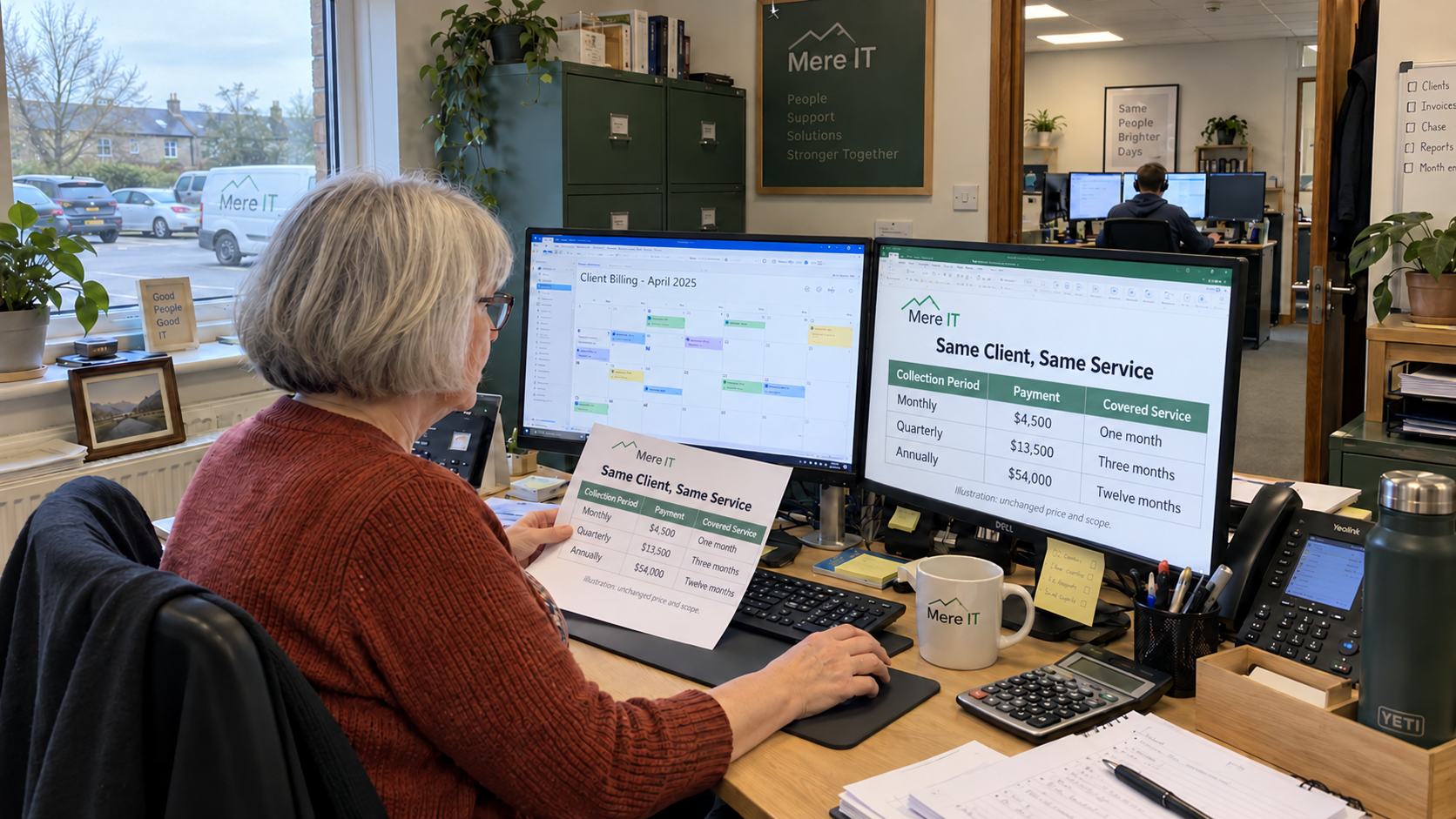
Assume the US model’s $4,500 monthly managed-service fee stays unchanged throughout the covered period. A year paid in advance is $4,500 × 12 = $54,000; monthly collection starts with $4,500. The annual vs monthly billing decision changes cash timing, not the total service price in this example. Choose a schedule the client can approve and your team can reconcile without giving away recurring revenue.
Billing frequency means how often you invoice. Payment timing means when the money actually arrives. Agree both, because an annual invoice nobody's paid hasn't brought any cash forward.
Compare the Same Service at the Same Price
Keep the service commitment constant when comparing collection options. The model favors a flat monthly fee with clear scope. Collecting several months together doesn't require turning that service into a bank of hours or changing what the client receives.
The following comparison assumes the same covered estate and no price change within the prepaid period. It excludes separate products and taxes. If those conditions differ, calculate the actual agreement rather than applying these totals to the whole invoice.
| Collection Period | Service Fee Collected at Its Start | Annual Service Fee if Unchanged | Decision to Test |
|---|---|---|---|
| Monthly | $4,500 | $54,000 | Can the client approve a recurring payment and can billing maintain the monthly record? |
| Quarterly | $4,500 × 3 = $13,500 | $54,000 | Does grouping the payments fit the client’s approval process without creating difficult adjustments? |
| Annually | $4,500 × 12 = $54,000 | $54,000 | Will the client authorize the advance, and can both parties administer changes during the covered year? |
Against the first monthly collection, the annual option brings forward $54,000 − $4,500 = $49,500 at the start, assuming both payments arrive then. That is the initial timing difference. It isn't an extra $49,500 of annual service revenue.
A discount isn't free financing. The model says to protect monthly recurring revenue and place a sales concession on a bonus item instead. Compare the schedules at the same service price before discussing a different commercial arrangement.
Choose From the Client’s Approval Process
My default would be monthly advance collection for a client whose purchasing process already supports it. It keeps the payment period close to the service period being administered. That is an operating preference to test with the client, not proof that monthly always wins.
Offer quarterly collection where the client prefers grouped approvals and can handle the larger payment. Check what happens when the covered estate changes partway through the period. The administrative benefit depends on how the adjustment will be handled, rather than on sending fewer invoices alone.
Consider annual advance collection where the client specifically wants it and the agreement can support a clear adjustment process. Confirm who approves the advance and when payment can actually be made. A purchasing contact’s interest isn't the same as payment authorization.
Avoid a client-size rule that chooses the schedule automatically. The model supplies no revenue cutoff at which a business should prepay. A client’s procurement process and likely service changes are more useful inputs to this decision.
Write the Change Rules Before Taking the Advance
Agree how a change in covered seats affects the prepaid balance. Identify who confirms the change and how finance records the resulting adjustment. Don't leave the account owner to invent a method after the client asks to remove a user.
Keep the annual price increase visible too. If an agreed increase falls inside the period being prepaid, split the calculation at that date using the appropriate monthly prices. The opening example holds the price constant for comparison; it doesn't cancel the model’s contracted annual increase.
Discuss termination and any refund treatment with the people responsible for the agreement before offering the schedule. Keep the resulting terms available to finance. Taking payment annually doesn't by itself establish either an annual contract term or a right to retain every unused amount.
Have the accountant confirm how the advance is recorded and reported. A cash-timing illustration can't determine your tax treatment or justify assuming that every prepaid amount is immediately distributable profit.
Forecast the Work the Cash Must Fund
Put the actual receipt date into the cash forecast and retain the service costs across the period they will be paid. Payroll doesn't go annual because the client did. Keep the future service commitment beside the cash balance when deciding what the business can spend.
Show the forecast under the client’s accepted schedule, with the actual supplier payment timing. Don't assume a client’s annual advance settles an annual supplier commitment if the services or amounts differ. Check the obligations separately.
A rule of thumb can't staff the prepaid year. Use your delivery plan and expected costs to assess the cash that remains available. Where a material adjustment or refund is unresolved, identify the exposure rather than treating the whole receipt as spare cash.
Keep the recurring monthly service value in the management report. A large annual receipt can otherwise look like a sudden sales improvement followed by an empty month. Finance should be able to explain the collection movement without confusing it with a change in the underlying client book.
Give the Billing Owner a Reconciled Record
For each advance, finance should record the exact covered period and its pricing basis. Link the payment to the client’s agreed service record. Have the account owner verify any approved change before finance changes the balance.
Keep consumption-based items distinguishable where the service has separately agreed variable charges. Erick Simpson offers advance invoicing for standard managed services with a later run for usage items as a billing option. That practitioner suggestion helps separate known charges from items awaiting data; it doesn't authorize a charge the client hasn't agreed.
Before moving an existing client to a new schedule, explain the first invoice and what period it covers. Simpson also recommends explaining new invoice items in advance. Check for overlap with amounts already collected so a schedule change doesn't bill the same service period twice.
When the client pays, reconcile the receipt to that record rather than only marking the invoice settled. Keep subsequent credits or additions linked to the same covered period. A prepaid arrangement should remain explainable after the person who sold it is away.
Make the Next Offer Concrete
Ask the account owner which schedule the next client can actually authorize. Have finance calculate the amounts from the agreed monthly service price and document the adjustment process. Then review the cash forecast with the owner before sending the offer.
Use the client’s answer to select the collection schedule, while keeping the recurring service price intact. The useful result is earlier cash you can explain and a future commitment you have planned to deliver. A larger opening receipt alone isn't enough evidence to choose annual billing.

mspoutpost.com/articles/annual-vs-monthly-billing-compare-cash-and-commitment
Written by Graham Whitfield
MSP Outpost publishes information, not legal, financial, insurance, tax or compliance advice, and reading it creates no professional relationship. For decisions about your business, talk to a qualified professional.