
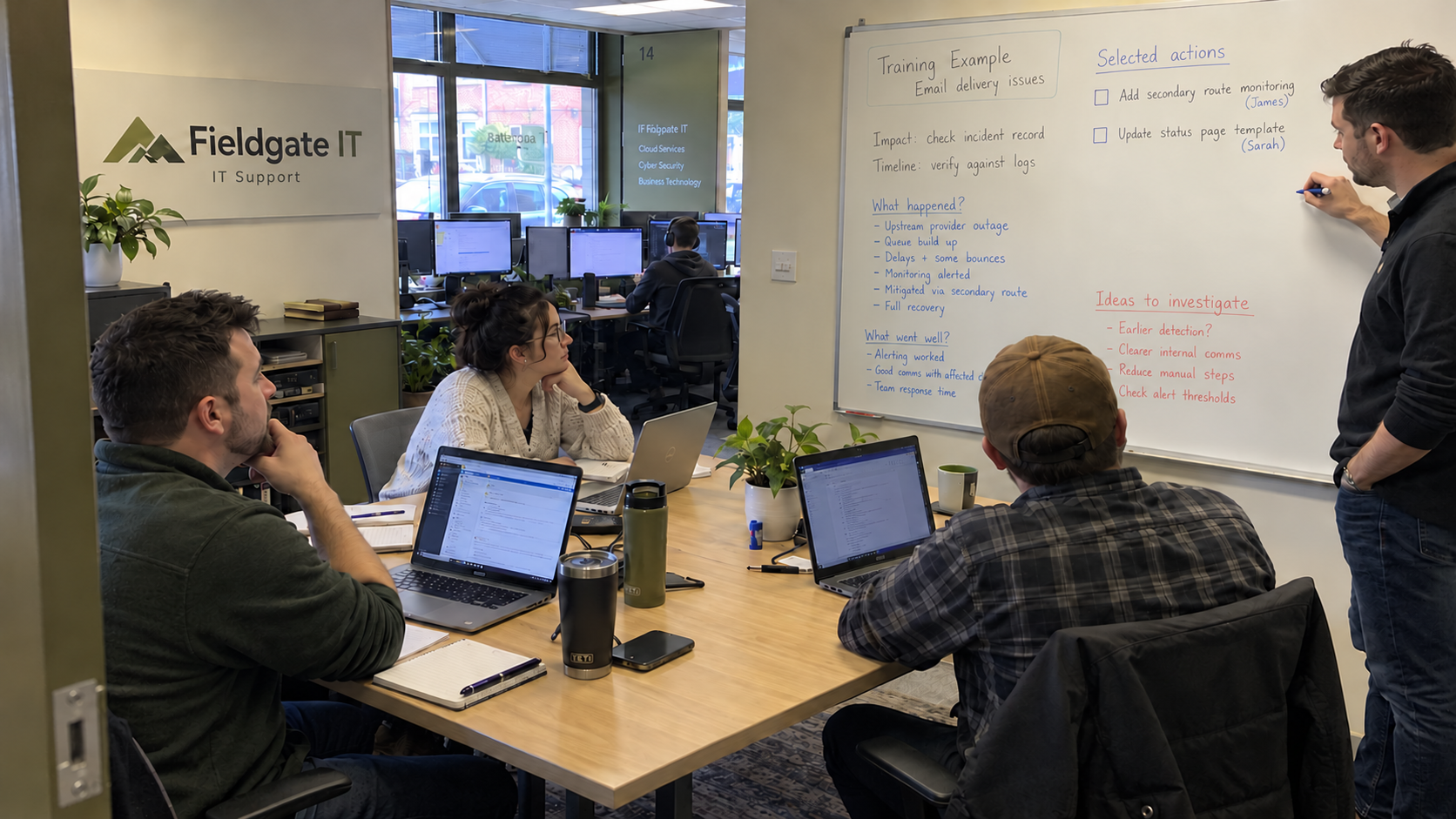
I'd book 45 minutes for a blameless postmortem, with the aim of leaving with two assigned improvements the team can verify. Reconstruct the incident before choosing those fixes. Keep other unresolved risks in the work record, with owners, rather than dropping them to make the action list look tidy.
Can the person receiving each follow-up tell what to change, what success looks like, and who can approve the work? If the review only produces a reminder to be more careful, the desk hasn't received a usable task. A reminder won't write the rollback plan.
Make the Review About the Work
A blameless review examines the conditions and decisions behind an incident without using the meeting to put a colleague on trial. It still needs an accurate record of actions and clear responsibility for improvements. Removing personal accusations doesn't require removing the event that needs explaining.
State the purpose before inviting the team. Ask participants to bring the records and questions needed to understand the work. Don't promise that holding a meeting guarantees people will feel comfortable reporting mistakes; give them a process that treats their account seriously and checks it against the evidence.
Keep active recovery and investigation responsibilities in place. Agree the review's timing with the people doing that work and make sure its scope and information-sharing fit the incident process. A discussion about learning shouldn't interrupt an urgent action or replace the response record.
Build the Timeline Before the Meeting
Name a review owner to assemble the timeline from the incident record, relevant tickets, changes, and communication. Mark what is confirmed, what someone recalls, and what remains unknown. Ask participants to correct the draft without treating disagreement as a personal challenge.
Keep the recorded time and its source beside each event. Where records disagree, preserve that difference until someone can resolve it. A tidy sequence built from guessed times can create a false explanation of the delay.
Record the service impact and the checks used to confirm recovery. Separate the technical result from outstanding client communication or follow-up work. The review needs to know what was actually restored before deciding which part of the response worked.
Choose participants from the work involved. The technical responder can explain the diagnostic decisions; the communication owner can explain what information reached clients. Bring the person who can approve the resulting work, without inviting every colleague to a detailed review they can't help resolve.
Run the Proposed 45-Minute Agenda
Here's how I'd use the 45-minute booking. These are proposed timeboxes for the facilitator to try with the team. If the evidence needs more investigation, record the unanswered question and its owner instead of rushing to a cause so the meeting can finish.
| Time | Work in the Meeting | Owner |
|---|---|---|
| 5 minutes | Confirm the incident being reviewed, its impact, and the aim of improving the work rather than blaming a colleague. | The facilitator states the purpose; the recorder opens the action record. |
| 10 minutes | Check the prepared timeline against the records. Separate confirmed events from recollections and unanswered questions. | The review owner leads; responders correct the record and name missing evidence. |
| 15 minutes | Examine what people knew and what conditions shaped their decisions. Check the recovery response as well as the initial trigger. | The facilitator asks the questions; technical and communication owners explain their part. |
| 10 minutes | Select two improvements from supported findings. Give other unresolved risks an owner and priority in the work record. | The service lead agrees capacity and authority; each selected action owner accepts the task and its verification. |
| 5 minutes | Read back each action, approver, completion date, and verification check. Confirm who will follow up. | The recorder reads the commitments; the facilitator confirms agreement before closing. |
Ask What Made the Action Reasonable
Walk through the timeline and ask what the person knew, what they expected, and what the procedure or tool showed. Compare that account with the records. Keep an unsupported explanation open rather than adopting the first plausible story.
Picture a hypothetical technician applying an approved change to the wrong client environment. The review should establish how the target was selected and checked. A missing client label, an unclear procedure, or a check that wasn't performed are different findings with different possible corrections.
Ask which information was available before the change and which appeared afterward. If the technician followed an instruction that identified the wrong target, rewriting the instruction is relevant. If the instruction was correct but unusable in the working interface, the team needs to inspect that interface too.
Melissa Hockenberry recommends investigating why staff couldn't carry out an intended service process before reacting with a fix or blame. Her practitioner examples include missing templates and changed submission processes. Apply that question here, while checking the actual incident rather than assuming a missing tool explains it.
Check the Response as Well as the Trigger
Follow the incident from detection through recovery. Examine where the next action waited for information, access, approval, or a capable person. The original fault and the delay in recovering from it may need separate improvements.
- The incident lead explains when coordination began and how responsibilities were handed over.
- The technical responder identifies which tests helped, which results were misleading, and what evidence supports that view.
- The communication owner compares the agreed updates with what clients actually received.
- The service lead checks what happened to unrelated support work while responders were occupied.
- The business decision-maker explains any approval dependency and confirms who can change it.
Include actions that helped the team recover. Keep a useful check or escalation route in the standard process rather than treating the review as a search only for faults. A successful workaround still needs its limits recorded before someone reuses it elsewhere.
Turn Findings Into Changes You Can Check
Cut 'improve operational resilience' from the action list. Name the control, instruction, access arrangement, or communication step that will change. The person accepting the task should be able to explain what they will deliver without attending another meeting to decode it.
| Finding in the Hypothetical Review | Proposed Follow-Up | Completion Evidence |
|---|---|---|
| The change record did not clearly identify the client environment. | The change-process owner adds the required target identification and verifies how it appears in the working record. | A reviewed example shows the target clearly, and a colleague can identify it without a spoken explanation. |
| Recovery waited for a person whose authority had no agreed cover. | The service owner agrees a qualified delegate and the decisions that person may authorize. | An approved walkthrough demonstrates that the delegate can find the information and follow the decision route. |
Those are possible changes for the hypothetical findings, not a diagnosis of your own incident. Choose your first improvements from the actual risk and evidence. Give remaining findings an owner and priority so a short starting list doesn't hide urgent work.
Have each action owner accept the task and agree a completion date. Name who approves the change and who verifies its result. If the owner lacks time, access, or authority, resolve that before describing the work as assigned.
Close Actions With Evidence
A completed edit isn't automatically a working improvement. Check whether the revised instruction, access route, or tool behaves as intended through an approved test or suitable walkthrough. Don't recreate an unsafe production incident to prove that the review was useful.
Record the check and any remaining limitation with the action. If the test fails, keep the work open and decide the next step. Separate a task somebody has marked complete from an improvement the designated reviewer has verified.
A quieter period afterward doesn't establish that the change prevented recurrence. The same conditions may not have happened again. Use the verification evidence and later incident records to decide whether the control still needs work.
Put the Learning Back Into the Desk
Share the approved lesson with the colleagues who need it, using information appropriate to that audience. Update the relevant procedure and show the team what changed. Keep the incident reference so someone can understand why the instruction exists without relying on an informal story.
The model says to fix service delivery before adding clients. Give these changes a place in the workload alongside current support, with the service lead resolving conflicts. An action list without capacity is still work the desk hasn't staffed.
Take a completed incident record and draft its timeline with the people involved. Identify the unanswered factual questions before booking the review. Finish with accepted actions, a way to verify them, and a named person checking that the work reaches completion.

mspoutpost.com/articles/blameless-postmortem-turn-the-review-into-assigned-work
Written by Megan Friesen
MSP Outpost publishes information, not legal, financial, insurance, tax or compliance advice, and reading it creates no professional relationship. For decisions about your business, talk to a qualified professional.