
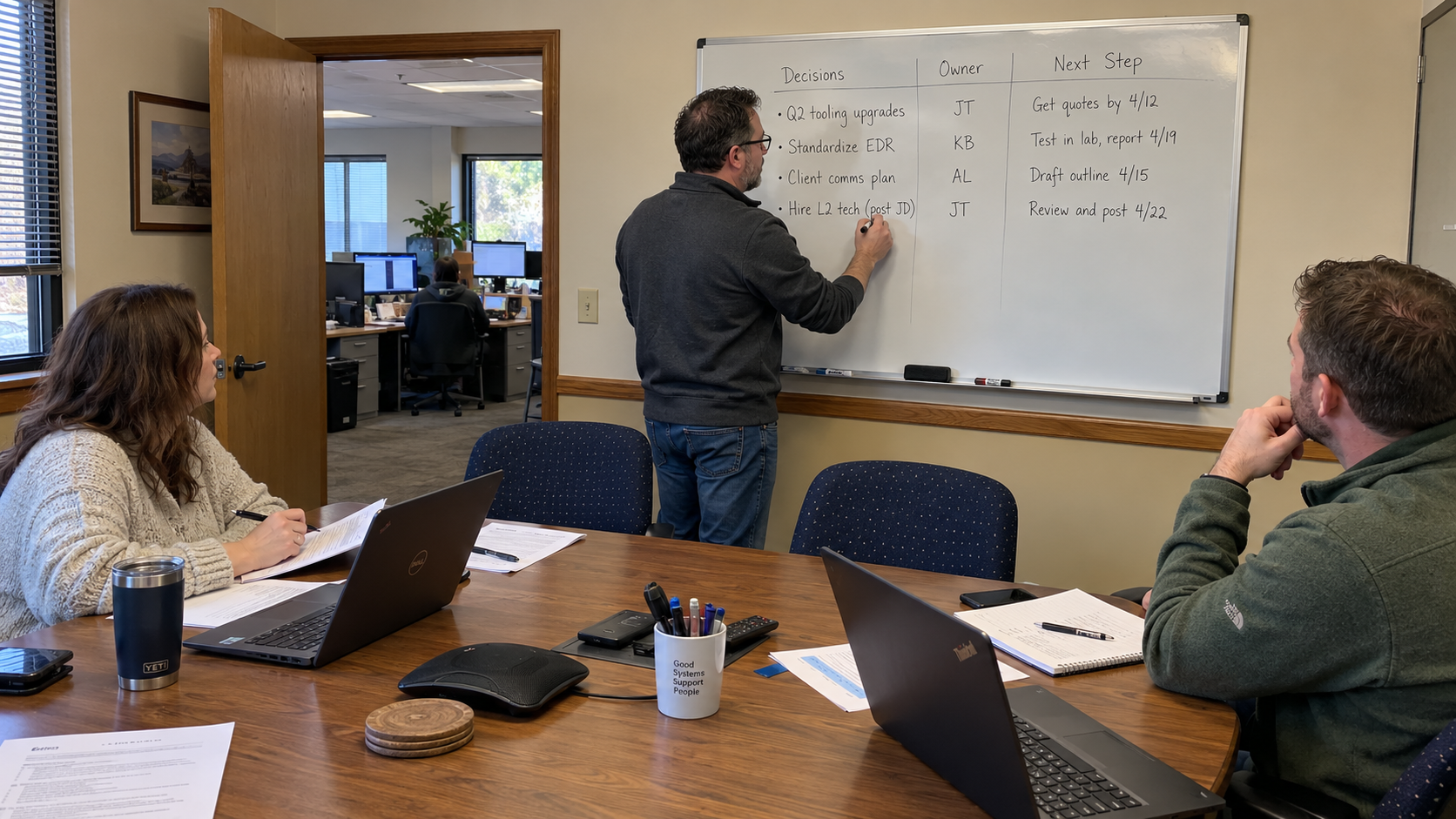
A leadership meeting agenda should name the decisions that require the people in the room. Put routine reports in writing beforehand. Use a weekly check for commitments, a monthly review for the operating numbers, and a quarterly session for choices about the business, then remove meetings that repeat those jobs.
That is the rhythm I'd start with, not an industry benchmark. Change it to fit the decisions and service commitments your team actually has. Attendance and a full slide deck don't establish that leadership work happened.
Cut the Report-Reading Meeting First
Here is what I'd cut: a round of updates that repeats information already available to everyone. Keep the information, move it into the shared agenda before the meeting, and use the conversation for a decision, a disagreement, or a request for help.
On a podcast, Erick Simpson describes collecting presenters' reports beforehand so they remained available if an urgent issue prevented attendance. He also questions keeping people for sections that don't involve them. That's his meeting practice, and a useful way to design the invitation list.
Name who prepares each report and when it must be available for the planned discussion. If a figure hasn't been checked, label it and assign the verification. Don't use the meeting to invent a confident explanation for a number nobody can trace.
Keep the people who can decide or supply information needed for that decision. At a small MSP, a person may hold several responsibilities. Invite the responsibility you need, rather than building a meeting around titles the business doesn't have.
Give Each Meeting a Different Job
Use the same action record across the rhythm. It should show the decision, owner, due date, expected result, and evidence of completion. A monthly review shouldn't have to reconstruct what the weekly conversation agreed.
| Meeting | Decisions to Bring | Record to Leave Behind |
|---|---|---|
| Weekly Commitments | Blocked actions, conflicting priorities, and promises needing a decision before the next review | Accepted actions, owners, and changes to commitments |
| Monthly Operating Review | Differences between the plan and the actual financial, delivery, and sales results | Investigations or resource changes, with checked assumptions |
| Quarterly Direction | Which priorities to continue, stop, or fund differently | Revised priorities and a capacity and budget decision for each |
Paul Green separates management discussion about growth, progress on actions, and operational conversations about clients or technical issues. He suggests different scheduling where operational discussion consumes the growth meeting. His distinction is useful: a leadership discussion needs a boundary before a live technical problem takes the whole agenda.
Route incident handling through the existing service or incident process. Bring its business decision into leadership where needed, such as a resource conflict or a client commitment the service lead can't resolve. Don't keep every attendee in the room for the technical investigation.
Use the Weekly Check to Resolve the Block
Have action owners update progress before the discussion. During the meeting, take the items needing a decision. Ask what is blocked, what information is missing, and who can authorize the next step.
A request to finish a report and a decision to change pricing aren't interchangeable actions. Give each a completion condition. If the same item returns, inspect the dependency, capacity, or decision that remains unresolved instead of adding a louder reminder.
Count actions due and actions completed against their stated evidence in the shared record. Also record decisions deferred because the required person or information was missing. I would change the invitation list or preparation when that missing input is what repeatedly prevents the decision.
Don't make completion counts a reason to split work into impressive-looking fragments. Check the actual result. A closed action that leaves the original decision untouched shouldn't count as progress toward that outcome.
Read the Monthly Numbers From Their Sources
Use finance's completed-period accounts, the service team's workload records, and the sales pipeline with consistent definitions. Compare actual results with the plan. Assign uncertain data for checking before using it to justify a hire or a larger marketing budget.
Picture a meeting where the marketing update celebrates more website visits and more form submissions. After the change, the update shows which inquiries reached an attended, qualified conversation in the CRM, what happened next, and what the work cost. You can then ask whether more spending is justified, rather than applauding a larger counter.
Marketing can't repair an offer whose delivery costs exceed the price you can sustain. The model's position is to fix the service factory before adding clients. Put the delivery constraint beside the growth request, with the person responsible for resolving it.
For each proposed spending change, state what result you expect, where it will be recorded, and what would make you change the decision. Use your own approved target and cost assumptions. The model doesn't supply a universal meeting score or a conversion threshold for every MSP.
Make the Quarterly Review a Choice About Work
Review the priorities against the result each was supposed to produce. Continue work that still has a funded purpose. Change or stop work whose assumptions no longer hold, then decide what capacity becomes available. Don't carry everything forward because nobody volunteered to remove it.
On a podcast, Foojee's Lucas Acosta describes a quarterly goal to review inconsistent discounts in PSA contracts. He assigns the audit to finance leadership and client communication to collaborating leaders, making clear that prices wouldn't simply change without client conversations. That's a concrete example of dividing the leadership work instead of leaving the owner to do every part.
Apply that shape to your own priority. Name the investigation, the decision it enables, the person who will carry out the approved change, and the capacity each part needs. A strategy session that approves work without those people or hours has approved an intention.
Keep urgent decisions out of the calendar trap. If a material cash or client problem needs action, handle it through the responsible people when it arises. The quarterly date is for reviewing direction, not permission to wait.
Measure What the Meetings Consume and Decide
Track the attendee time from the calendar beside the decisions and accepted actions in the shared record. Compare the same definitions before and after changing the rhythm. Note other changes that could explain a different result, such as staffing, workload, or a revised reporting system.
I'd cut a recurring meeting if its material can be read, its decisions belong elsewhere, and no participant can name a remaining job for the conversation. If a useful decision lacks the right people, fix the attendance. If the facts aren't ready, fix preparation.
- The owner defines the job of each recurring meeting and removes duplicate discussions.
- Each functional lead supplies checked information and flags unresolved inputs before the relevant meeting.
- The chair names the decision required and confirms who has authority to make it.
- Each action owner accepts the result, date, and evidence they will provide.
- The chair maintains the shared decision record and checks whether the next agenda still needs the same people.
Take the next leadership invitation and mark every item as information, discussion, or decision. Move information to the written record. Keep the conversation that can change the work, with the people able to make that change.

mspoutpost.com/articles/build-a-leadership-meeting-agenda-around-actual-decisions
Written by Owen Gallagher
MSP Outpost publishes information, not legal, financial, insurance, tax or compliance advice, and reading it creates no professional relationship. For decisions about your business, talk to a qualified professional.