
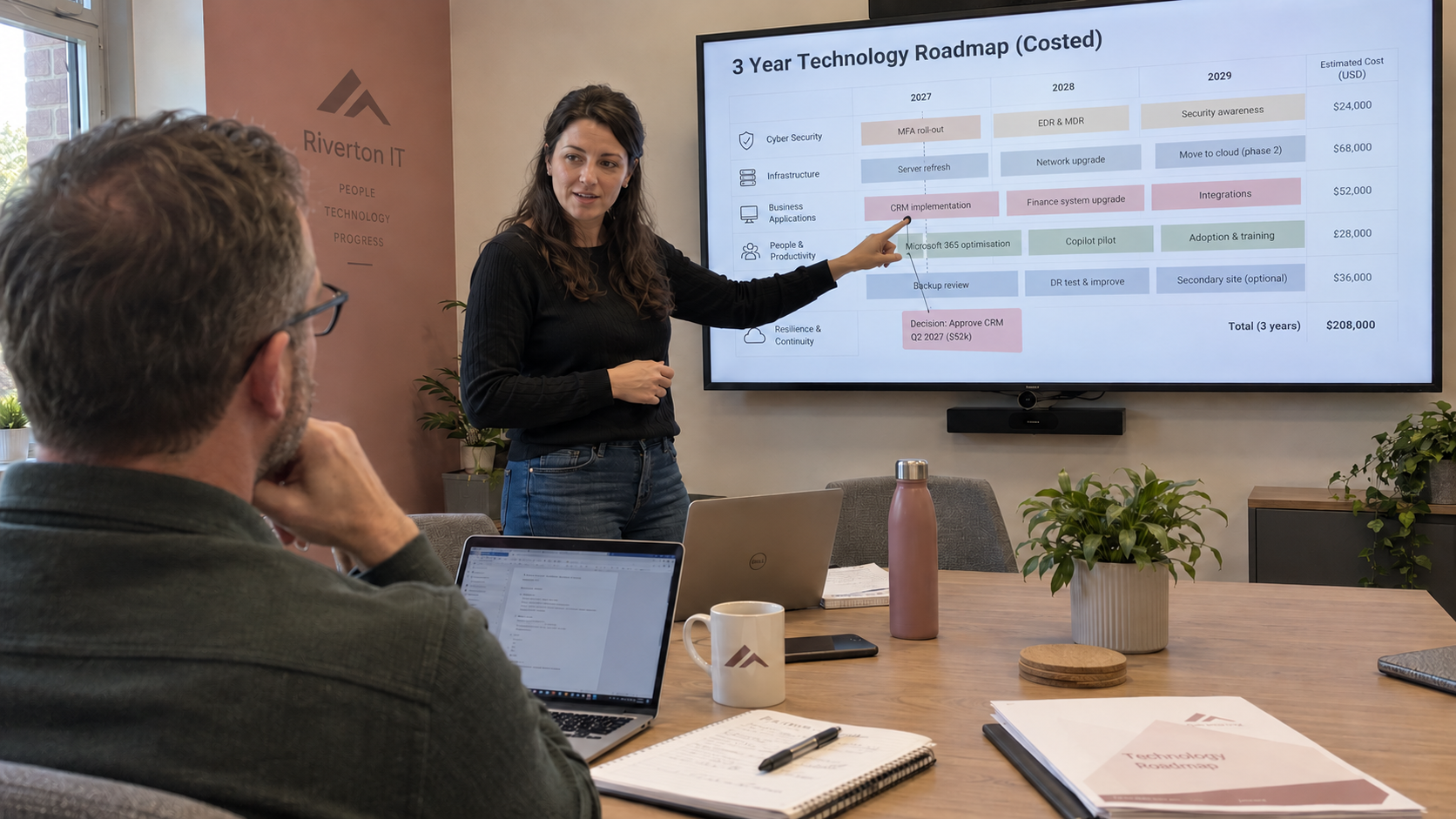
Build vCIO pricing around the decisions your MSP will help the client make and the work needed to support them. Define the deliverables, check the time and skills they need, then price the delivery cost. A strategy label on an agreement doesn't create room in anyone's calendar.
I'd cut an offer that promises access to strategic advice without saying what the client will receive. Before the change, you have a meeting and an open invitation to ask questions. After it, the client has a costed plan, a record of decisions, and a clear boundary around further work.
Sell the Deliverables You Can Inspect
A virtual chief information officer, or vCIO, owns the business conversation and technology budget in the MSP model. The technical alignment manager handles standards and the environment. Keep that split visible so a technical report doesn't silently become the whole business-planning service.
I'd scope the offer around these deliverables and agree the detail with the client. Each needs an input from the technical team or the business and an output someone can use. A completed meeting is only part of that work.
| Deliverable | Work to Include | What to Record |
|---|---|---|
| Technology budget | Gather the expected technology spending and the client's priorities, then review what can be funded. | The proposed spending, assumptions, and decisions the client has made. |
| Roadmap | Order the agreed work against business needs, technical dependencies, and the budget. | The next action, decision owner, and changes to the plan. |
| Quarterly business review | Prepare the business conversation, review the plan, and follow up on the decisions. | What was approved, deferred, or left unresolved, with a named next owner. |
Keep new-business hunting separate from these account responsibilities, as the model recommends. A vCIO can identify a need for a project without turning every review into a sales presentation. Price the planning work whether or not the client chooses to buy the project.
Use the Hours as a Planning Assumption
The model allows 3 hours per client per month for vCIO work, including the quarterly review. It allocates 5 hours a quarter to that review within the workload assumption. Preparation and follow-up need to fit too; the allowance isn't a promise that every client needs the same time.
For the example MSP's 35 clients, 3 hours each gives 105 hours a month. The model's revenue staffing basis is one vCIO per $140,000 of managed monthly recurring revenue, producing 1.13 vCIO full-time equivalents in the example. The hours cross-check comes to 1.08 full-time equivalents.
Those calculations describe the same modeled business. Their agreement doesn't validate the assumptions against your clients. The model keeps staffing on the revenue basis and uses the hours to check the workload, so record both when building your own delivery plan.
Check when the work falls as well as its monthly average. Review preparation can arrive alongside a client budget deadline or another commitment. A role allocation that fits across the year may still need different scheduling or cover during those periods.
Put the Cost Beneath the Offer
The model's US vCIO salary is $90,000. At the general 1.25 burden multiplier, annual burdened pay is $112,500. This is a labor cost; keep any other delivery costs visible when pricing the complete service.
The model has 1,660 available annual hours at 70% service utilization, giving 1,162 productive hours. Divide $112,500 by 1,162 for about $97 of burdened labor cost per productive hour. At the assumed 3 monthly hours, that is about $290 of labor cost per client per month.
Use your actual compensation and workload before quoting from that illustration. If the scope needs more preparation or a different skill mix, change the inputs. A rounded hourly cost cannot tell you that the deliverables fit the budget.
Check Whether the Managed Seat Already Pays for It
The MSP model puts vCIO work in delivery labor inside the managed-service fee. Its example charges $225 per seat per month. Check that the scope you're offering matches the work that fee is meant to fund before adding a separate vCIO charge.
I'd keep the role's allocated cost visible in the service pricing record. A missing invoice line doesn't make the work free. Equally, adding a line for work the existing agreement already includes doesn't establish that you're providing a new service.
For a genuinely separate engagement, cost its own scope and commitments. The model's managed-service margin target is 50%, fully loaded with burdened delivery labor and tools. Add the remaining delivery costs to the labor estimate before dividing the complete cost by 0.50 to price at that target.
The wider business still needs to fund overhead and fair-market owner pay. Check the contribution against that plan rather than treating the delivery margin as distributable profit. Write down what the standalone fee includes and what requires another agreement.
Measure the Work Behind the Review
Keep time records for preparation and follow-up alongside the client meeting. Record requests outside the agreed scope separately so they don't disappear into a general account-management total. That lets you see which part of the offer needs a different price or a tighter boundary.
I'd compare the actual effort with the deliverables promised. If time runs over, find the reason before cutting the conversation or hiring another person. Missing technical inputs, unclear decisions, and extra advisory requests need different responses.
A longer review isn't automatically more useful, and a shorter one isn't automatically more efficient. Inspect whether the client received the agreed work and whether the next decision has an owner. Meeting duration alone cannot settle that question.
Cut Work That Doesn't Serve the Agreed Decision
I'd cut duplicated reporting where the client already has the same useful information elsewhere. Keep the technical detail available when it supports a decision, rather than spending the review reading it aloud. Confirm what the client actually needs before removing a deliverable they rely on.
Revisit a roadmap that has no spending decision attached. Identify what the client can fund and what remains a proposal, then record the difference. An unaffordable project list needs a budget conversation before it becomes a delivery commitment.
If the scope changes, update its cost and the agreement together. Keep the old baseline so you can tell whether improved margins came from better delivery or simply providing less work. The number worth defending is the contribution from the service you actually promised.
Make the Next Offer Specific
Start with a vCIO deliverable already in your agreement. Trace the inputs, the preparation, and the follow-up required to complete it, then compare that work with the funded role. Use the gap to revise the scope or the price.
Before you market the revised offer, name who will deliver it and where its work fits. Give the client a clear output and a decision they can make from it. That is a stronger offer than a strategic title your team has no time to fulfill.

mspoutpost.com/articles/build-vcio-pricing-from-the-work-you-actually-deliver
Written by Owen Gallagher
MSP Outpost publishes information, not legal, financial, insurance, tax or compliance advice, and reading it creates no professional relationship. For decisions about your business, talk to a qualified professional.