
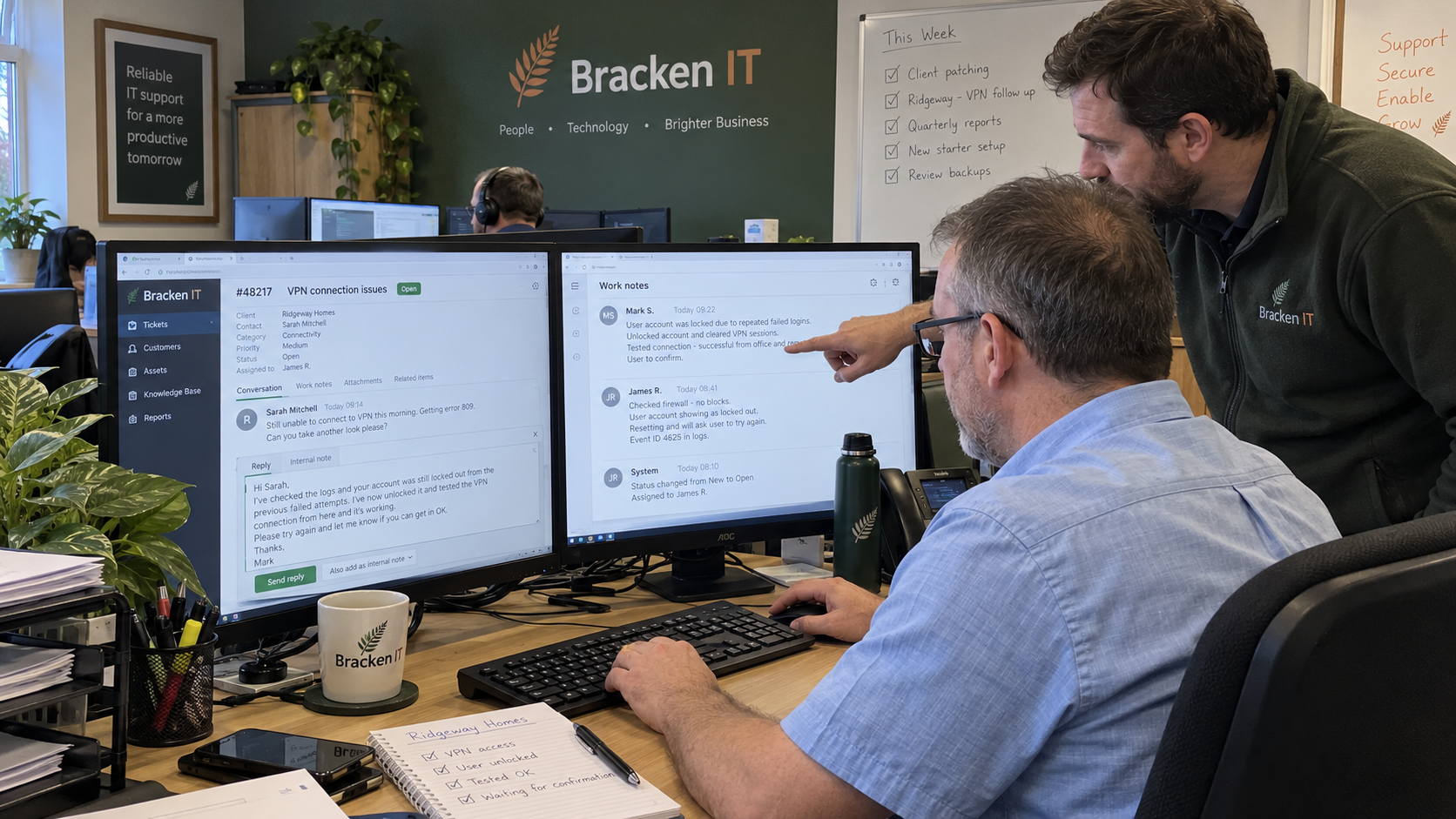
Keep five customer service email templates for the MSP desk, each matched to a real work state. Tell the client the next action and who owns the next update. A calm message is useful only when its promise has someone behind it.
Use the drafts below as reusable wording, not automatic statements of fact. Replace every bracketed field with checked information. The ticket owner must confirm the state before choosing the reply.
Separate Receipt From Work Started
An acknowledgment confirms the request was recorded. It shouldn't imply a technician has begun investigating unless that happened. An automated receipt hasn't picked up a screwdriver.
J2 defines response in its published agreement as acknowledgment and the start of assessment, while saying resolution duration varies with the issue. That is one provider's definition. Check the commitment in your own agreement instead of treating every automatic email as proof of an achieved response.
The service lead owns the mapping between the ticket state and the client-facing message. Check it with a real request before automating the reply. Give the queue owner a way to correct a message that describes the wrong state.
Received: Record the Request Accurately
Use this before investigation has been confirmed. The queue owner makes sure the request reaches the supported intake process. Keep any urgent route consistent with the actual service agreement.
Subject: Your request is recorded [ticket reference]

Hi [client name],

We've recorded [reported issue] as [ticket reference]. Our desk will assess it through [agreed coverage and priority process].

Reply here if the business impact changes so we can update the request. For an urgent issue, use [agreed urgent route] and quote the reference.

[Support team]
Use the client's reported problem, not a guessed diagnosis. If the request arrived through a private inbox, put it into the agreed process before giving the sender a reference. Don't send them away with an instruction to start again while nobody owns the original contact.
Investigating: Describe the Actual Check
The assigned technician uses this after starting a specific investigation. Name a useful check instead of saying the team is working hard. Get the update owner's agreement before putting their commitment in the message.
Subject: Investigation update [ticket reference]

Hi [client name],

I'm checking [specific action] for [reported issue]. So far, we've confirmed [verified finding]. The next action is [next step].

[Update owner] will update you by [date, time, and time zone], even if the investigation is continuing. Please reply here if [relevant impact change] occurs.

[Technician name]
That due time promises communication, not a completed repair. If there is a supported resolution estimate, explain its conditions separately. Don't insert a standard completion duration because the cause is still unknown.
Waiting: Keep the Dependency Owned
The current owner names what progress depends on and who must provide it. The MSP still needs an accountable follow-up. A waiting state shouldn't remove the request from review.
Subject: Next input needed [ticket reference]

Hi [client name],

We need [specific input] from [responsible person or organization] before [dependent action] can proceed. We've already [verified request or follow-up].

[Named MSP contact] owns the follow-up and will update you by [date, time, and time zone].

[If the client must provide information, describe the approved reply or secure transfer route.]

[Ticket owner]
Delete the optional instruction when the client has nothing to supply. Use an approved secure route for sensitive information; don't request passwords in an email reply. A waiting label also doesn't establish that a contractual clock has stopped.
Resolved: State What Was Verified
Keep your technical check distinct from the client's confirmation that the affected work is usable. This version asks for confirmation after the MSP's checks are complete. Follow the actual closure process rather than inventing client agreement.
Subject: Please check the result [ticket reference]

Hi [client name],

We've completed [specific action]. Our check was [test], which showed [observed result].

Can you now [affected business task]? If the issue remains, reply on this ticket with what happens so we can continue from the existing record.

[Include a known limitation and its follow-up owner where applicable.]

[Technician name]
If confirmation already exists, accurately record it instead of asking again. Remove the optional limitation line when it doesn't apply. A successful test mustn't become a client conversation that never took place.
Escalated: Confirm the Receiving Owner
Send this when the specialist has actually accepted the escalation. The original owner checks the handoff before changing the client message. A queue change alone doesn't prove another person has started work.
Subject: Specialist handoff confirmed [ticket reference]

Hi [client name],

[Receiving person or team] has accepted the investigation of [specific issue]. They have the completed checks and the current business impact.

[Communication owner] remains responsible for your updates and will contact you by [date, time, and time zone]. You can reply on this ticket without opening another request.

[Communication owner]
If help has only been requested, say that instead. Keep the current assignment and follow-up visible until acceptance. Don't tell the client a specialist is investigating while the request still waits for someone to receive it.
Give Every Promise a Work Record
Skip proactive communication alignment as a desk instruction. The service lead approves reusable wording against the service provided. The sending technician verifies the ticket-specific details, and the communication owner accepts the promised update.
Record that commitment with its due time. The queue owner checks due and missed updates and reassigns them when someone becomes unavailable. Include the context needed to make the next message useful.
Paul Green recommends planning how clients receive incident updates and who handles worried callers while technical responders work. He also asks how the plan operates when the owner is unreachable. That is his planning advice; use the same absence check for routine communication owners.
Keep routine messages consistent with the approved incident communication route. If an incident lead is coordinating the explanation, the desk shouldn't send a conflicting template. Have the communication owner establish which message applies.
Check the Next Update Against the Queue
On Monday morning, can the queue owner find the next promised update and its responsible person on the open request? Fix a missing assignment before calling the communication complete. A polished message doesn't deliver its own follow-up.
Inspect missed updates alongside the real work state. Waiting for vendor input and waiting for an internal handoff need different action. Fewer client replies alone don't prove the template improved service.
Take the next message due from the desk and compare it with the ticket. Confirm its state and the work record behind its next promise. Save the checked wording where the team already prepares replies so the same verification can happen next time.

mspoutpost.com/articles/customer-service-email-templates-for-five-msp-updates
Written by Megan Friesen
MSP Outpost publishes information, not legal, financial, insurance, tax or compliance advice, and reading it creates no professional relationship. For decisions about your business, talk to a qualified professional.