
Decide how much raise to give employees from a funded pay-review budget. Start with the revenue you expect to earn from scheduled price changes, deduct the other cost increases you need to cover, and retain the profit your plan requires. Then cost individual pay decisions at burdened pay before approving them.
The MSP model's annual price step is 5%, written into the agreement and communicated ahead of time. That does not create an automatic 5% payroll increase. The price notice does not approve payroll.
Count the Price Increase You Can Actually Bill
Use the client agreements and effective billing dates. Confirm which fees receive the increase and whether the required notice has been given. Keep uncertain changes separate from changes you can put into the revenue forecast.
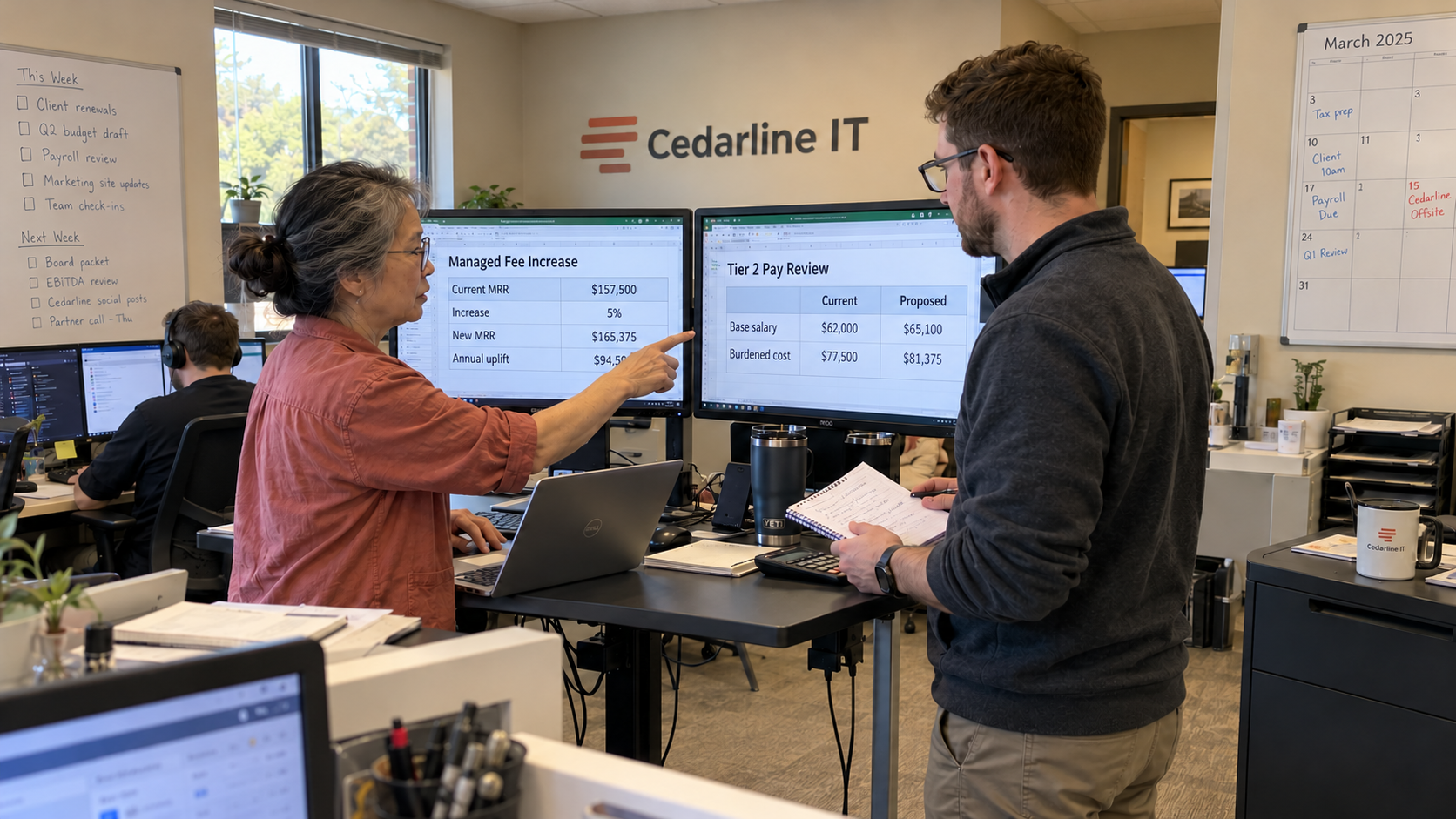
Take a hypothetical version of the model's US example. It has $157,500 of managed monthly recurring revenue, or $1,890,000 annually. Hold the seat count, client base, and other revenue unchanged for this calculation, and assume the entire managed fee receives the 5% increase at the start of the year.
The annual managed-revenue increase is $1,890,000 times 5%, or $94,500. The monthly increase is $157,500 times 5%, or $7,875. Those figures describe the same uplift over different periods; don't add them together.
If client increases begin on different dates, calculate the amount earned after each effective date in the budget year. The full annualized uplift is not what you earn during a partial year. Update seat changes and departures separately instead of hiding them inside the price assumption.
Retain the Profit Target Before Assigning a Pay Pool
The example starts with total annual revenue of $3,634,615 and EBITDA of $730,276. EBITDA is earnings before interest, taxes, depreciation, and amortization. The model counts it after a fair-market owner salary and targets 20% of revenue.
Adding the $94,500 price uplift produces $3,729,115 of revenue. If every cost stayed unchanged, EBITDA would become $824,776. That is a comparison before new spending, not the amount available for pay increases.
| Calculation | Annual US Example |
|---|---|
| Starting revenue | $3,634,615 |
| Managed-fee uplift at 5% | $94,500 |
| Revenue after the uplift | $3,729,115 |
| EBITDA if costs do not change | $824,776 |
| 20% EBITDA target on the new revenue | $745,823 |
| Remaining room for all added costs | $78,953 |
The last line is $824,776 minus $745,823. It gives about $78,953 of additional cost capacity while retaining the 20% target under these assumptions. It is not a recommendation to spend that amount on raises.
Put tool and supplier changes, planned hires, overhead, and other commitments into the same forecast before setting the pay pool. An increase that protects margin against those costs cannot also fund an unrestricted pay promise. Recalculate the result when the assumptions change.
Cost a Raise at Burdened Pay
For a single-employee example, use the model's US Tier 2 salary of $62,000 and the general burden multiplier of 1.25. Existing annual burdened cost is $77,500. The multiplier covers the model's payroll taxes, benefits, and insurance assumptions.
Test a hypothetical 5% salary increase to match the price step in this example. The salary increase is $3,100, taking base pay to $65,100. At the same 1.25 multiplier, new annual burdened cost is $81,375, an increase of $3,875.
The pay pool therefore needs to fund $3,875 for this decision, not just the $3,100 salary change. This uses 5% as a scenario built from the model's price step, not a model recommendation that every employee should receive that raise. Use the actual proposed amount for each person.
Keep costs outside the multiplier visible. The model excludes paid time off, bonuses, recruiting, training, equipment, and software from that burden factor. Use the appropriate capacity and expense lines rather than assuming the salary calculation pays for everything.
Choose Individual Changes Within the Funded Budget
The total pay pool tells you what the plan can fund. It does not decide the right change for each employee. Review the role, responsibilities, current pay position, and observed development before proposing an individual amount.
Keep a promotion or changed role distinct from a general pay adjustment. If the person will take on different work, update the delivery plan and the cost of covering what they leave behind. A new title cannot supply capacity the desk no longer has.
Use current information relevant to your roles and location when reviewing pay. The model salary is a US planning input, not a promise about the right rate for every technician. Record the basis for the decision so the next review does not start from memory.
Check the Effective Dates in the Cash Forecast
A planned revenue uplift and a recurring payroll commitment can start on different dates. Put the client receipts and the new payroll payments into the cash forecast when you expect them. Inspect the available balance before approving a commitment the business must keep paying.
Keep collections risk visible. A higher invoice is not a bank receipt, and a delayed price increase does not delay a raise you have already put into effect. Decide how the business will fund that timing difference rather than treating the annual profit calculation as cash cover.
Use a scenario for price changes that happen later than planned or costs that arrive earlier. Keep the assumptions on that scenario so you can compare it with the budget. Choose the response from your actual funding and commitments, without borrowing a universal reserve amount.
Give the Budget and the Conversation Named Owners
I'd complete these checks before managers communicate individual decisions. Each line needs someone who can confirm the record.
- The account or billing owner confirms the contract basis, advance notices, affected fees, and effective dates.
- The financial owner calculates the in-year revenue uplift and updates the other cost commitments.
- The service lead records role changes, training needs, and the capacity effect of the proposed pay decisions.
- The payroll or financial owner costs each proposal with the applicable burden and effective date.
- The owner approves the total commitment after checking the EBITDA target and cash forecast.
- The manager explains the individual decision, its effective date, and any separately agreed development actions.
Keep an unapproved proposal labeled as a proposal. If the business cannot fund the requested change, state the decision and what will be reviewed next without promising that a future client increase will settle it. The model's principle is to run healthy margins so you can pay good people well.
Start with the dated client increases and the actual payroll proposals. Calculate the revenue, protect the profit target, and cost the people before the conversations begin. That gives the pay review a budget you can explain and a commitment the business has checked.

mspoutpost.com/articles/decide-how-much-raise-to-give-employees-from-your-budget
Written by Megan Friesen
MSP Outpost publishes information, not legal, financial, insurance, tax or compliance advice, and reading it creates no professional relationship. For decisions about your business, talk to a qualified professional.