
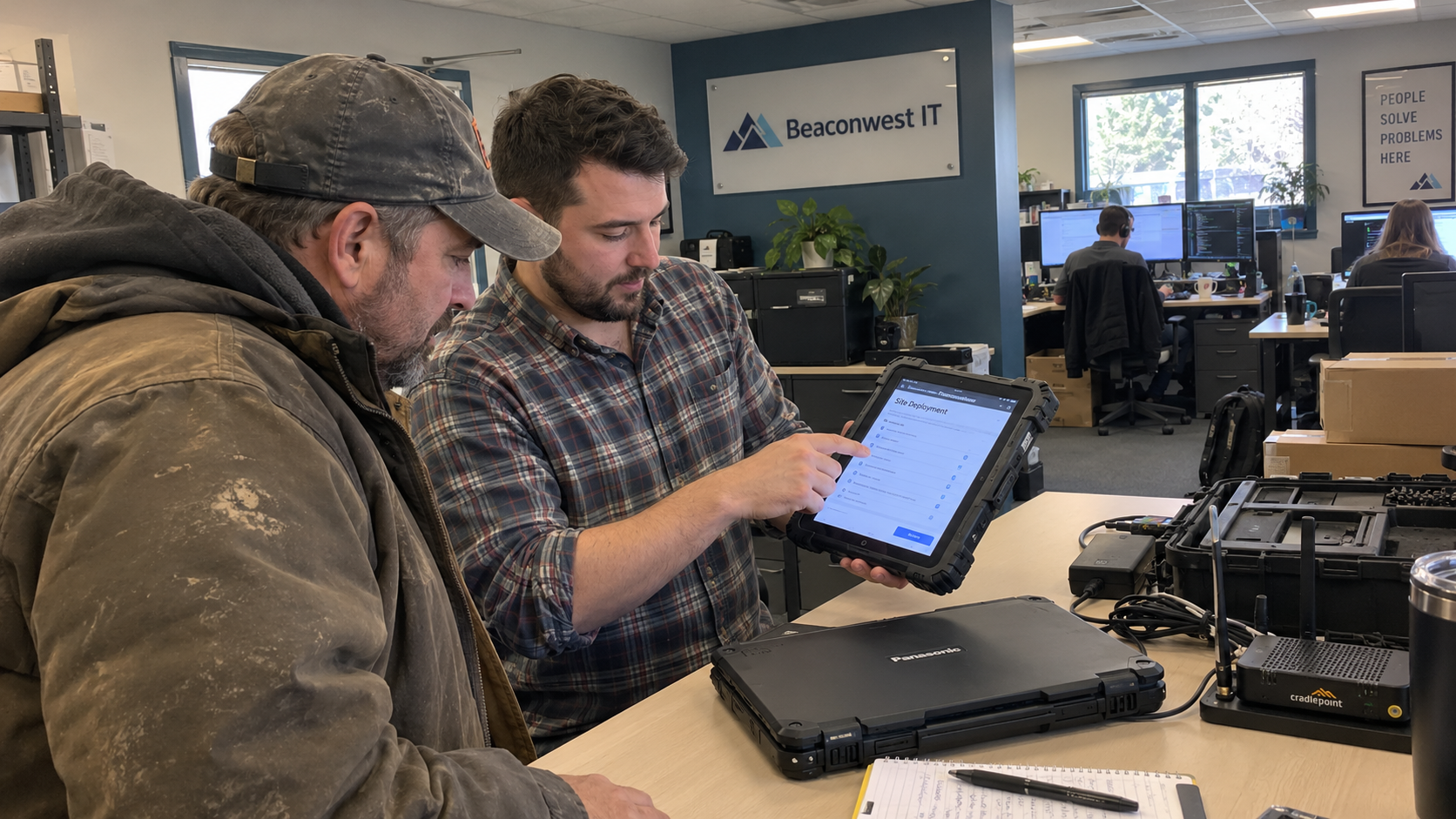
Before: 'We provide IT for construction companies.' After, as a proposed offer: 'We manage your office and crew devices, with a defined connectivity and support arrangement for each job site.' The second version gives you work to scope and price. Build the package around the responsibility your MSP can accept, then test that promise against actual delivery cost.
I'd cut the claim that you keep every crew connected everywhere. A coverage problem doesn't disappear because the website calls you a construction specialist. Sell a stated service boundary and show the buyer what happens when work falls outside it.
Start With the Crew’s Actual Work
Ask a prospective customer to demonstrate a routine field task using the device they carry. Follow the task back to the office system it depends on. Don't choose a rugged tablet and then search for a reason the crew should use it.
Record the conditions your package must support. Use a discovery sheet with these fields:
- The field task and the application the crew needs to complete it.
- The people using the device, including how shared devices change hands.
- The physical working conditions and the charging arrangement.
- The locations where connectivity is needed and what work must continue without it.
- The support hours, contact method, and person able to help with a physical check.
- The application vendor or client team responsible when the problem is outside your service.
Use the answers to define an approved device configuration for that work. Keep it compatible with your standard management approach rather than creating an unrelated support stack for every new customer. Vendor Derik Belair recommends mapping tools to their function and service offering, while cautioning that constant tool switching can discard technician familiarity. That's his operating advice, rather than a reason to buy another tool for the package.
Choose Devices Against the Working Conditions
Make ruggedness a selection question with evidence behind it. Check the proposed model's published specifications against the conditions on your discovery sheet.
Include the accessories needed to perform the demonstrated task in the quote. Confirm the replacement route with the supplier, and tell the buyer what happens while a damaged device is away. Don't describe an ordinary warranty as your own immediate replacement commitment.
Propose a representative field test before rolling the configuration out. Have the client perform the agreed task where it will actually happen, with the application owner available to resolve application questions. Record the result and any limitations the customer accepts before ordering the wider deployment.
Treat Each Job Site as a Defined Service
Create a site record before adding a recurring site fee. Name the location and the equipment you're managing, then specify the service start and removal arrangements. A temporary site needs an agreed end to billing as well as an installation plan.
Test the proposed connectivity arrangement at the place the crew will use it.
Agree who orders the carrier service and who can authorize changes to it. If your MSP manages a router but doesn't control the carrier network, say how you will diagnose and escalate a carrier fault. A managed device and a guaranteed connection are different commitments.
Discuss a fallback with the customer for work that can't wait. Check whether their application supports the proposed disconnected workflow rather than assuming it does. Describe a backup connection only after checking its own availability and the failure it is intended to cover.
Put the Package Boundary in the Quote
Separate the recurring responsibilities from purchases and deployment work. The buyer should be able to tell which line changes when a crew grows and which changes when another site opens.
| Quote Line | What You Define |
|---|---|
| Managed seats | The counted users or devices, supported applications, security baseline, and support hours |
| Job site management | The named site equipment, remote management, supplier escalation, and any included visits |
| Devices and accessories | The approved configuration, ownership, warranty route, and separately agreed replacement provision |
| Connectivity | The carrier contract owner, recurring charges, limits, and cancellation responsibility |
| Deployment or site move | The agreed installation or relocation work and how additional work is approved |
Keep baseline security in the recurring offer rather than making it the premium option. Check how the model's required security baseline applies to shared crew devices before promising that every device can be handled identically. Include that work in your delivery estimate.
Package names don't create a meaningful difference in service. In a practitioner discussion, Eric Anthony favors distinct price and value levels, while Justin Esgar describes wanting to combine offers whose differences he found weak in practice. Use their disagreement as a reason to explain the actual work, rather than as evidence for a particular number of tiers.
Price Seats and Sites Without Counting Work Twice
The US model's example seat price is $225 a month. For a hypothetical customer with 20 billable seats, that gives $4,500 in monthly managed service revenue. This is an example built on the model, not a construction-sector price survey or a promise that the workload fits that fee.
Keep a site charge for additional site responsibility that isn't already included in that seat price. Estimate its monthly delivery labor at burdened pay and include the tools needed for that work. Count expected travel or physical attendance in the service where you have agreed to provide it; don't leave those hours out because a remote support tool is installed.
The model sets a 50% managed-service gross margin target after burdened delivery labor and tools. For a site-management service with monthly loaded delivery cost D, divide D by one minus that target percentage to calculate the required revenue. Use your measured cost to fill in D, and avoid counting the same monitoring or technician time in both the seat and site estimates.
Hardware has a different target: 30% gross margin in the model. Calculate the selling price by dividing actual hardware cost by one minus that target percentage. Adding 30% to cost is a markup and doesn't produce a 30% margin. Keep hardware revenue and its cost separate from the managed-service calculation.
Show the buyer the total recurring commitment with the charge for each component identified. Define how the count changes and when the site fee stops. A per-seat headline that conceals unavoidable site charges won't explain the offer you're asking them to accept.
Measure Delivery Before Expanding the Offer
Count the labor used to support the package in the service records, including site visits. Record supplier escalations against the affected site so repeated carrier problems don't disappear into general support. Keep hardware margin in the purchasing and sales records instead of blending it into a single impression of a profitable account.
Compare managed revenue with the same period's loaded delivery cost against the model's 50% target. The number that would change my mind about expanding the package is a recurring margin below that target, with the work correctly recorded. That doesn't automatically mean the account loses money; it means the current offer hasn't earned expansion on the planned economics.
I wouldn't count page views of the construction landing page as proof that this package works. Marketing can't supply a technician for a visit you never priced or make an unavailable connection reliable. Check whether qualified buyers accept the defined responsibility and whether delivery can carry it at the intended margin.
Build a draft quote from a demonstrated crew workflow and a real site assessment. Ask delivery to confirm the boundary and cost before you publish the offer. Expand the promise only when the support records give you a reason to believe you can keep it.

mspoutpost.com/articles/it-for-construction-companies-price-the-crew-and-site
Written by Owen Gallagher
MSP Outpost publishes information, not legal, financial, insurance, tax or compliance advice, and reading it creates no professional relationship. For decisions about your business, talk to a qualified professional.