
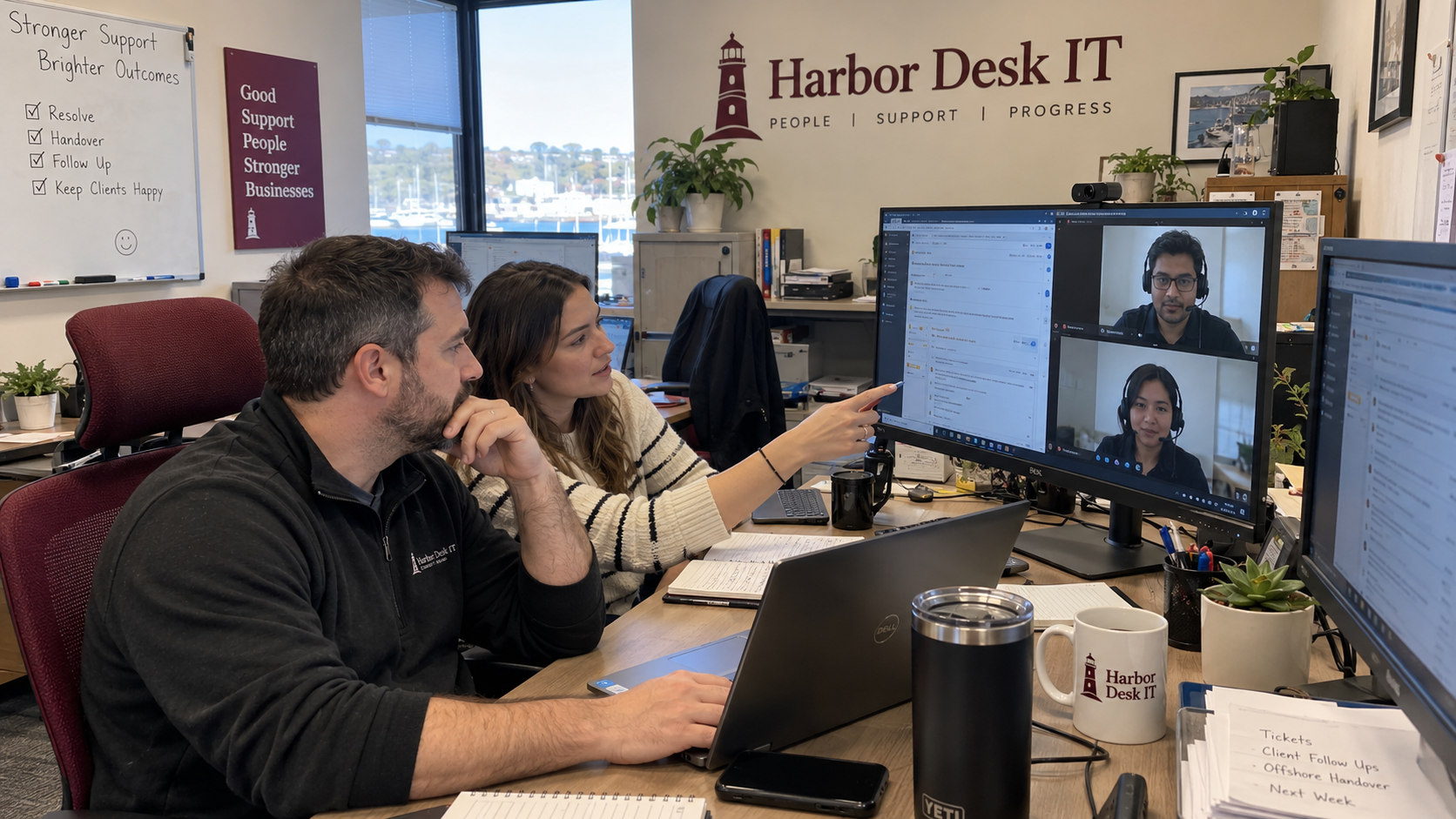
At 700 seats, the model's offshore service desk option reduces annual desk cost from $321,304 to $212,638. The reduction is $321,304 − $212,638 = $108,666, with its 15% night differential included. Tier 1 and Tier 2 work move to Philippines staff, while an onshore Tier 3 technician leads this particular arrangement. Treat that as an option to cost against your own workload.
The comparison holds ticket demand and labor assumptions constant. It uses the model's well-run rate of 0.5 tickets per seat per month; a typical MSP runs 1.0 to 1.4. Run the headcount at your own rate before borrowing the example's saving.
Before approving the plan, I'd ask: what does this do to the board on Monday morning? Name who receives the work, who handles an escalation, and who can decide that the arrangement isn't ready. A spreadsheet won't pick up the escalation.
Know What the Pay Figure Includes
The model's direct-hire option uses $15 per paid hour, fully burdened, and 173.33 paid hours per month. That gives $15 × 173.33 = $2,599.95, or about $2,600 per person per month before the night differential. The 15% differential applies when Philippines staff work their night shift to cover the example's business hours.
The calculation is $15 × 173.33 × (1 + 15%) = about $2,990 per person per month. Annual cost is $15 × 173.33 × (1 + 15%) × 12 = $35,879.31, or about $35,879 before rounding the monthly display. The model applies no night differential when the work is during the Philippines daytime.
These are the model's cost inputs, not a supplier quote. Ask what your actual price includes and how coverage is staffed. Keep supervision and the remaining onshore work visible when comparing the total with your current desk.
Keep Both Sides of the Headcount
The example assigns Tier 1 and Tier 2 ticket labor plus residual monitoring-alert work to the offshore staff. That is 2.26 full-time equivalents of work, rounded up to three people. The onshore Tier 3 workload is 0.94 of a full-time equivalent, rounded up to one person.
| US Example Line | Onshore Pool | Offshore Tier 1 and Tier 2 Option |
|---|---|---|
| Desk staffing | 4 onshore people | 3 offshore people plus 1 onshore Tier 3 lead |
| Annual desk cost | $321,304 | $212,638 |
| Desk cost per seat per month | $38.25 | $25.31 |
| Annual EBITDA | $730,276 | $838,942 |
| EBITDA margin | 20.1% | 23.1% |
EBITDA means earnings before interest, taxes, depreciation, and amortization. The modeled margin difference is 23.1 − 20.1 = about 3.0 percentage points for the whole example business. It depends on the example's workload, staffing, and pay, including the whole-person rounding on each side.
The per-seat desk difference is $38.25 - $25.31 = $12.94 a month. Those are average desk allocations across the 700-seat business. A 20-seat client doesn't buy a fraction of an offshore employee at that price; size the shared desk before assigning its cost across clients.
Rounding costs the onshore example $64,358 a year above fractional staffing at load, and the offshore option $32,911. Without whole-person rounding, the modeled saving would be $77,219. For a smaller business, calculate the actual people required rather than shrinking the example's annual saving in proportion to seats.
Make Accountability a Design Decision
The model uses its onshore Tier 3 technician as the team lead. That is this arrangement's design, not a rule that only a Tier 3 technician can be accountable for a queue. Name a qualified owner who has the authority and available time to run your proposed arrangement.
Skip the location strategy talk. Name the person responsible for the queue. Then give the receiving team the escalation path and the decision rights that person can actually exercise.
Keep technical escalation coverage explicit even when queue ownership sits with another qualified lead. Decide who handles work the offshore team cannot resolve and how that person is reached. Project engineers continue to own project work and new-client onboarding in the model.
Check the Work Before Moving It
I'd test the documentation and standard build with the people who will receive the tickets. Ask them to work through suitable cases and record where the instructions or access are missing. That checks the dependencies without pretending documentation sets a universal ceiling on how fast an offshore team can resolve work.
Review repeat Tier 1 work for appropriate automation before moving it. The model's position is to send work to the least costly resource that can do it and automate level-one work rather than hire for it. Keep a qualified technician responsible for deciding which actions and environments are suitable.
- Desk lead: split logged ticket labor by resolving tier and keep human alert work separate. Check the sample for missing escalation time.
- Owner: divide the proposed offshore and onshore workloads by each role's productive hours, then round the people required on each side.
- Finance: price the actual arrangement, including the proposed coverage hours and any applicable night differential, alongside the retained onshore work.
- Technical lead: check the receiving team's access, runbooks, and standard client build against suitable tickets before changing routing.
- Queue owner: accept the escalation and handover process and name who decides what happens when a ticket cannot be completed.
- Owner: compare the cost and observed delivery results before deciding whether to move more work.
Keep the Decision Conditional on Your Result
Don't use the model's well-run ticket rate as your default when your own records show a different workload. Recalculate the required staff from actual ticket labor and alert work. Changing the ticket count, handling time, or quoted cost changes the comparison.
If the receiving team cannot complete the intended work with the current instructions and access, assign an owner to fix the gap before expanding the arrangement. If the queue has no qualified accountable owner, name one and give them time for the role. Neither problem is solved by choosing another hourly rate.
Bring the staffed cost comparison and the handover results to the decision together. Keep the owner of the queue and the retained onshore responsibilities in writing. The next step is a supported assignment on the board, with the cost of the people who will actually do it.

mspoutpost.com/articles/offshore-service-desk-cost-the-people-and-the-handover
Written by Megan Friesen
MSP Outpost publishes information, not legal, financial, insurance, tax or compliance advice, and reading it creates no professional relationship. For decisions about your business, talk to a qualified professional.