
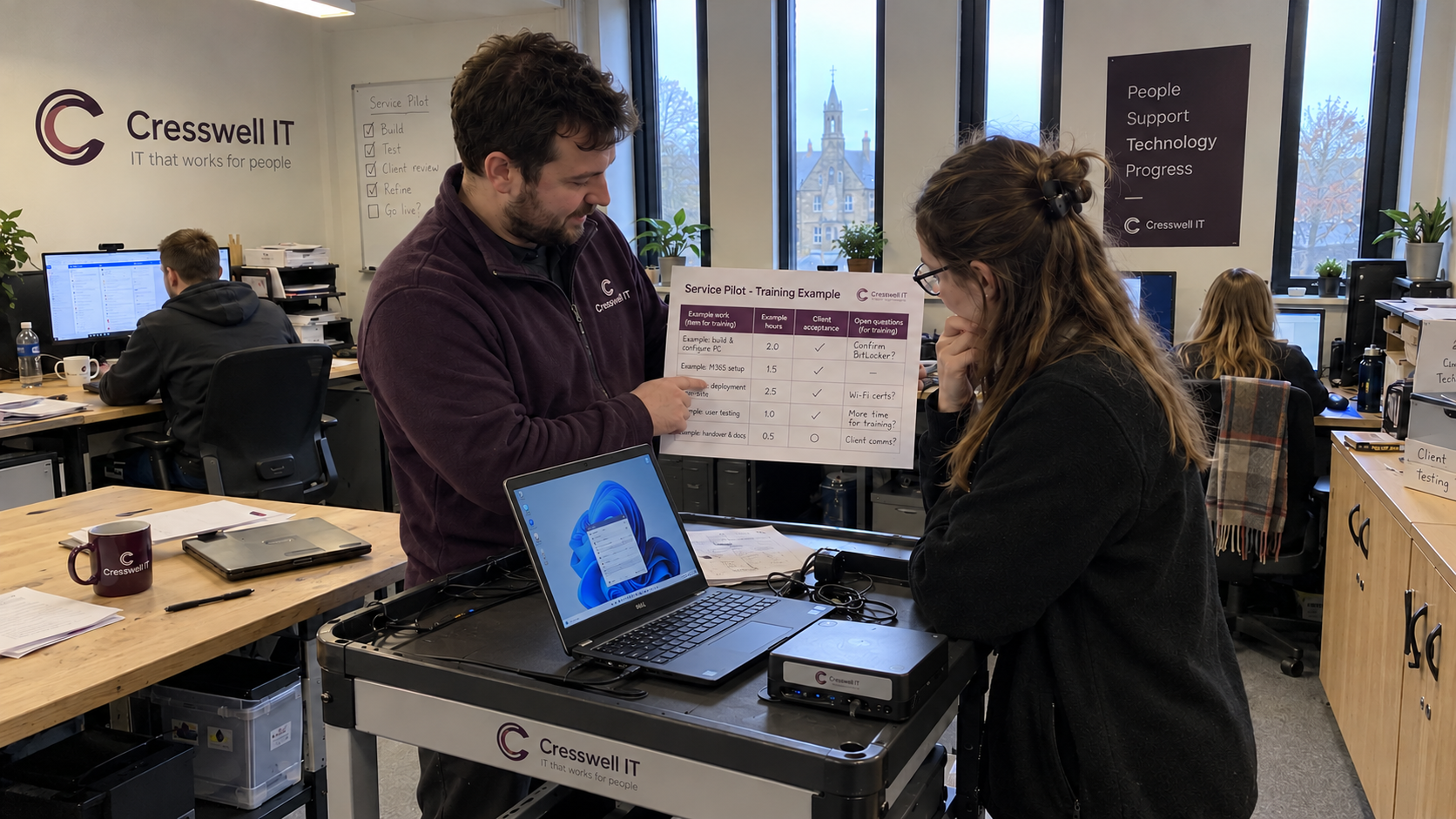
Picture a new service before and after a pilot program. Before, your proposal promises a useful result and delivery has an estimate. After, you should have the client's acceptance record and the actual work needed to produce that result. My view is that sign-ups alone don't justify putting the offer in front of the rest of your clients.
I'd start with three willing existing clients whose needs match the proposed scope. Treat that group as a place to learn, not a representative sample of the market. Agree the work and the review conditions before starting, then decide whether to sell the service more widely from what delivery actually records.
Write the Decision Before Recruiting the Clients
Set out what you need to learn about the offer. A useful question is whether the promised result can be delivered at the planned scope and price without relying on the owner to rescue it. A question about whether anyone likes the idea is too easy to answer with polite enthusiasm.
Write the offer in the same plain language a client would approve. For an ongoing managed service, the model favors a flat monthly fee with clear inclusions and exclusions. State what happens after the trial so a temporary arrangement doesn't become an unclear continuing obligation.
Choose the review date from the work you need to observe. Account for setup and the recurring activities the service is meant to include, and identify anything the period will leave untested. A calendar ending doesn't establish that an infrequent task has been delivered successfully.
Here is what I'd cut: the public launch campaign until the delivery decision is made. A landing page can describe a limited invitation, but it can't supply missing labor records. Don't make the sales promise bigger while the team is still finding out what the work involves.
Recruit for a Real Need, Then Record the Bias
Choose clients who have the problem the service is intended to address and can participate in checking the result. Confirm that they understand the proposed arrangement. Keep a note of the selection reasons so you can see which conditions helped the pilot work.
Vivienne Winborne recommends examining the existing client base for service gaps alongside recurring revenue when planning account growth. That's a practitioner planning approach you can use to identify a relevant need. It doesn't establish that every uncovered gap should become an offer.
Friendly clients may provide useful feedback, but their willingness doesn't establish wider demand. Record any extra cooperation your plan depends on. If the service only works with unusually available client contacts, that condition belongs in the later selling decision.
Ask the account owner to agree how the client will report a problem and who can accept the completed work. Keep delivery questions with the people doing the work. Don't turn the service manager into the account manager simply because the offer is new.
Keep the Trial Agreement Concrete
Use a short written scope that delivery and the client can both understand. Make it clear that participation is limited to the agreed work. Avoid implying that the client receives every future version of the service because they helped test this one.
- Describe the client result and the records that will show whether it was delivered.
- State the included work, exclusions, price, and approval needed for a change.
- Name the client contact and the MSP owners for delivery and commercial questions.
- Agree the review point and what continuing, changing, or ending the arrangement would require.
Keep the underlying service agreement visible. A trial label doesn't remove work your MSP already owes, and a newly named offer shouldn't charge again for that work. Resolve the scope boundary before recruiting the client, rather than asking the technician to explain it while delivering the service.
For recurring work, don't lower the monthly price simply to collect participants. The model rejects discounting recurring revenue to win a client. If the planned price prevents anyone with the relevant need from participating, record that as a commercial question rather than hiding it under a promotional rate.
Track Setup Separately From Continuing Delivery
Give the work a consistent identifier in the PSA or your chosen work register. Record actual labor against the participating client and distinguish initial setup from recurring delivery. Keep the underlying entries available so someone can investigate an expensive result instead of debating a total with no history.
Record the employee's role with the time, including work the owner performs as a technician. Cost the labor at burdened pay and account for nonproductive time through the utilization basis used in your costing. Don't treat an owner's contribution as free because it didn't create an extra payroll payment.
Keep supplier charges and the related service period with the cost record. Check whether a purchase supports just this offer or an existing included service, so the same expense isn't counted twice. Before committing to a tool, compare its actual commercial terms with what the limited client group needs.
Abhishek Bhargava recalls committing to subscriptions prematurely while entering managed services and advises owners to match tool commitments to their stage of business. That's his operating account, not a prediction about your purchase. Use it as a reason to examine the commitment before calling a new subscription a necessary pilot cost.
Compare the Same Scope and Period
For ongoing managed services, the model's gross margin target is 50% after burdened delivery labor and tools. Calculate the pilot's recurring revenue less the corresponding delivery costs, then divide that gross profit by the same revenue. Keep one-time setup visible separately so it neither disappears nor distorts the recurring service calculation.
If the offer is a project or a resold product, classify it before applying a margin target. The managed-service target isn't a universal target for every invoice line. Keep the offer's components separate when they have different delivery economics.
To test a recurring price, divide the recurring delivery cost by the share of revenue available for that cost at the target margin. At the model's 50% managed-service target, the cost allowance is half the price. That calculation is a pricing check; it doesn't establish whether a client will buy at the resulting price.
Keep the development work visible to the owner as a separate investment decision. Don't spread it across imagined future customers to make current delivery look profitable. Wider sales still need to cover the actual service and leave room for the business's overhead.
Use the Client Result Alongside the Margin
Count accepted deliverables in the client acceptance record and compare them with the agreed scope. Record support and rework hours in the work register, and reconcile supplier charges to the cost sheet. Keep the client's comments beside those records so a positive conversation cannot substitute for unfinished work.
The number that would change my mind is a forecast recurring managed-service margin below the model's 50% target after the recorded delivery work is costed properly. I'd hold the wider launch and investigate the cause. That is a proposed launch rule, not a claim that every service below the target loses money.
Marketing can't fix an offer that depends on unrecorded owner labor or an acceptance check the client won't agree to. It can test how you explain a credible offer and which clients respond. Keep those commercial questions distinct from whether delivery can keep the promise.
Make the Next Offer Match What You Learned
Compare each client's result before combining the costs. A strong average can hide a scope exception that would matter to the next sale. Keep the conditions that made delivery possible attached to the version you propose to launch.
If the recurring work meets the acceptance checks and the cost target, approve the actual scope and price for the next sales conversation. If the cost fails, decide whether the work can change without breaking the client result or whether the price needs testing. If the result remains unverified, finish that investigation before claiming success.
Changing the scope changes what you've tested. Confirm the revised work with the participants and identify which checks need repeating. If you stop, carry out the agreed ending steps and keep ownership of any outstanding obligations clear.
Before inviting the clients, open the work register and write the decision you will make from it. Give the offer a delivery owner who can explain the recorded cost. A completed pilot should leave you able to approve, revise, or stop a specific service, with the reasons available to the next person asked to sell it.

mspoutpost.com/articles/pilot-program-test-an-msp-service-before-the-wider-launch
Written by Owen Gallagher
MSP Outpost publishes information, not legal, financial, insurance, tax or compliance advice, and reading it creates no professional relationship. For decisions about your business, talk to a qualified professional.