
Three hours per client per month is the model’s vCIO workload allowance. Your vCIO job description needs to fit the business conversation inside that allowance without adding the technical alignment manager’s job. My test is what the hire does to the board on Monday morning. Client decisions need named follow-up, while desk work keeps its own owner.
Hire for the ability to turn a technical finding into a business decision the client can make. Test that ability with a work sample before offering the role. Then transfer responsibility through observed work, rather than assuming the person is ready because a date has arrived.
Write the Outcome Before the Candidate Profile
The model keeps the vCIO distinct from the technical alignment manager, or TAM. The TAM owns the environment and its alignment with standards. The vCIO owns the client’s business conversation and budget. That boundary should be visible in the job description and in the assignments that follow it.
For this proposed role, make the expected output a client decision record with a maintained technology plan. The vCIO should be able to explain why a recommendation matters to the client’s operations and what happens if it is deferred. They also need to record a client’s decision without turning every discussion into an immediate sales target.
Cut “strategic rock star” from the advert. Describe the work the person must demonstrate. A title cannot chair the meeting.
Keep new-business hunting separate too. The model treats account management as a different role from prospecting for new clients, and it keeps the service manager responsible for the desk. If your vacancy is actually a sales or dispatch problem, a vCIO title will leave that problem poorly specified.
Give Applicants a Job They Can Recognize
Use the following as a proposed responsibility section, adapted to the service you sell. The role reports to the owner in the model. Give the candidate enough detail about support from other roles to decide whether the expectations are workable.
| Responsibility | Expected Evidence | Working Boundary |
|---|---|---|
| Understand client priorities | A written account of the business requirement, confirmed with the client contact. | The vCIO asks about the business effect rather than assuming every technical finding has equal priority. |
| Translate alignment findings | A recommendation that connects the TAM’s evidence to a client decision. | The TAM retains responsibility for the technical assessment. |
| Develop the technology plan | A maintained plan with decision owners and the basis of proposed spending. | Project specialists validate implementation scope and estimates before they become commitments. |
| Lead the business review | A discussion that produces an explicit decision or an assigned question to resolve. | The meeting does not replace active incident handling. |
| Follow decisions through | An action record with ownership and evidence of the handover. | The vCIO routes delivery work to its responsible team. |
| Maintain the account record | Current priorities and decisions available to the people who need them. | The role uses the agreed client record rather than a private collection of promises. |
Require enough technical understanding to challenge an unclear recommendation and seek the right specialist. You are not asking the vCIO to diagnose every fault personally. Look for a person who can tell the client what is known and what still needs validation.
Ask candidates for an example they can discuss without revealing a former employer’s client information. Have them distinguish their own responsibility from the rest of the team’s work. A polished account of a successful project is incomplete evidence if you cannot tell which decision the applicant actually influenced.
Test the Work With a Consistent Exercise
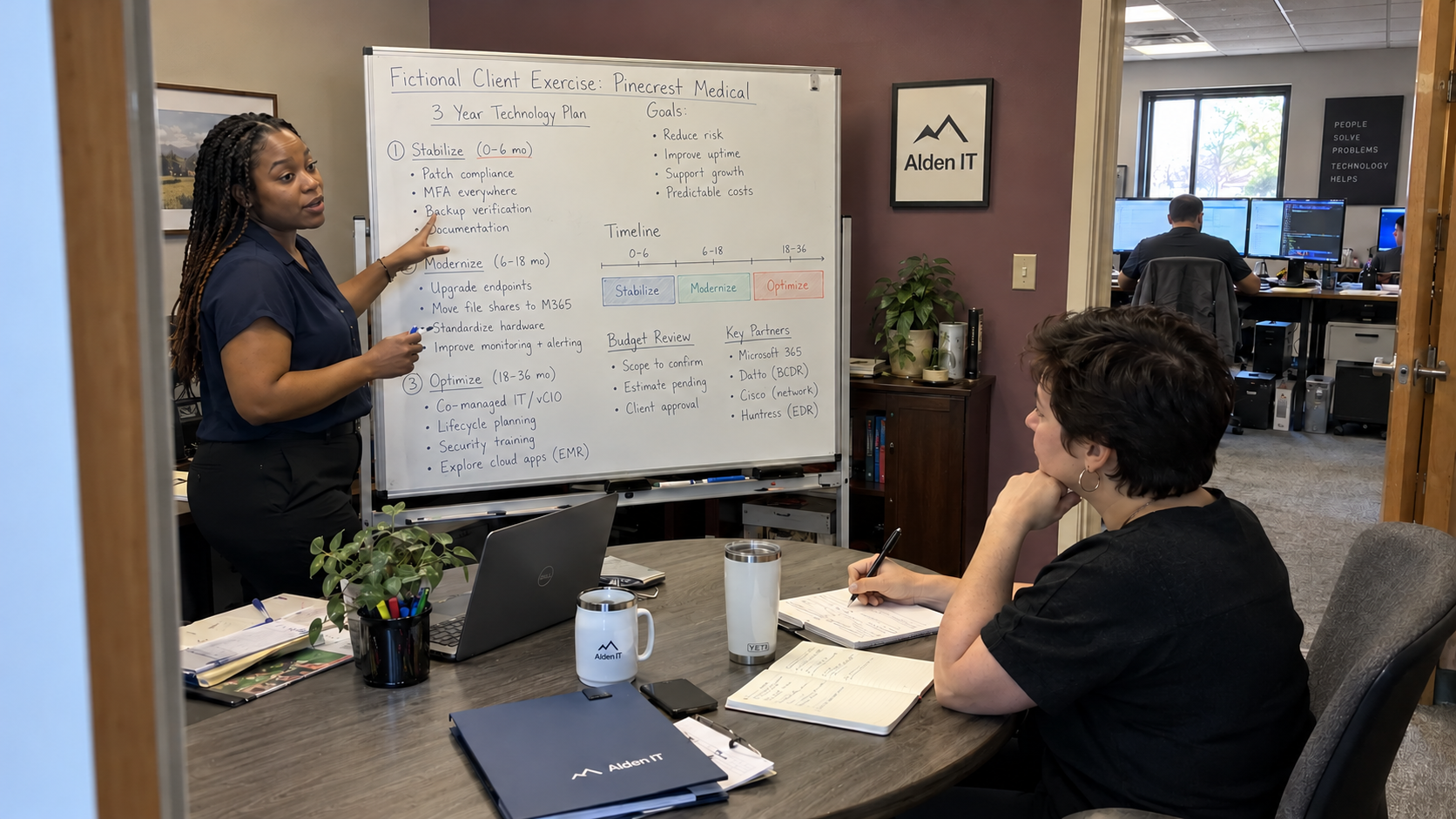
Give candidates the same fictional client brief and explain that it is an interview exercise. Include a business priority alongside a technical finding whose financial estimate remains unverified. Ask the candidate to prepare for a client conversation using only that supplied information.
The useful test is whether they recognize the missing input and ask for it. They should explain the recommendation in business terms while keeping uncertainty visible. Do not reward someone for inventing a confident implementation price from an incomplete brief.
Play the client who wants to defer the work. Ask: “What would you need to understand before recommending that we wait?” Listen for the information they would seek and how they would explain the consequence, rather than a rehearsed insistence that everything is urgent.
Then ask them to write the resulting action record. It should make clear what was decided and who must resolve what remains open. Compare the written record with what the candidate said in the conversation, because an attractive presentation can still leave a poor handover.
Have the owner assess business judgment while the TAM checks whether the technical evidence was represented accurately. Ask the service lead whether the resulting action can be assigned without another discovery conversation. Keep the assessment criteria consistent across applicants and record the evidence behind each decision.
Check the Capacity and Cost You Are Offering
The model staffs the vCIO role at $140,000 of managed-service monthly recurring revenue per full-time equivalent. It separately checks workload at three hours per client per month. Use the revenue basis to plan capacity, then test the actual assignments and review calendar rather than treating either figure as a guaranteed client limit.
The three-hour allowance includes the quarterly business review work. Do not add the same meeting again as though it sits outside the role’s monthly workload. If your service commitment is broader than the model assumes, show the additional work and the capacity it needs before giving it to the new hire.
The US model uses a $90,000 annual vCIO salary as a planning assumption. It has limited salary evidence and is not a current offer for your location or candidate. Cost the actual compensation package before deciding what you can fund.
Under the model, the vCIO sits in managed-service delivery labor and reports to the owner. Keep that service-cost treatment consistent when evaluating the account book. Owner support also needs real calendar space even though the model adds no separate management share for this role.
Transfer Responsibility Through Observed Work
Use progress checks tied to the job rather than a universal ramp-up timetable. Start with access to the agreed client records and an explanation of the role boundaries. The owner should confirm which decisions the new hire may make and which still need approval.
Have the new vCIO observe a business review and explain the resulting plan back to the owner. Check whether they can distinguish the client’s stated priority from the MSP’s interpretation. Resolve that difference before asking them to lead the next conversation.
Then give them a supported review to prepare and lead. The owner remains available for the decisions that have not yet been delegated. The TAM supplies the technical findings, and project specialists verify any implementation commitments before the plan is presented as ready.
After the meeting, check the action record and handover with delivery. Assign further clients when the observed work supports it and the capacity check allows it. If an output is incomplete, identify the coaching or missing support instead of treating the calendar as proof of failure.
Make the First Assignment Specific
Before recruiting, have the owner approve the responsibility table and the interview exercise. Ask the TAM to supply an appropriate fictional technical finding for that exercise. Have the service lead test whether the proposed follow-up can reach the right team.
Once someone starts, review the initial account assignments against the actual time available. Keep evidence of client decisions alongside the delivery handovers. The first hire earns confidence by producing usable business decisions within a supported role, with a clear next action when the work shows a gap.

mspoutpost.com/articles/vcio-job-description-hire-for-client-decisions
Written by Megan Friesen
MSP Outpost publishes information, not legal, financial, insurance, tax or compliance advice, and reading it creates no professional relationship. For decisions about your business, talk to a qualified professional.