You send the proposal on Thursday. By Tuesday there's silence, so you follow up. The reply is either "we went with someone cheaper" or "can you do 20% off?" Both sting, and both are fixable before the proposal ever leaves your inbox.
The fix is a structure: open on the client's own problem, put the monthly price next to it with a one-paragraph scope note, and ask for the signature on the review call. A proposal that reads like a mirror of the client's complaint gets read. A price that comes with a scope note survives the discount reflex. A call that asks for the signature gets one.
Why Your Proposal Gets Lost and Your Price Gets Cut
Picture the last one you sent. It probably opened with "Thank you for the opportunity to quote" and a paragraph about your company's history. The client skimmed it, saw a number, and filed it next to the other three identical documents from your competitors.
The problem isn't your price. It's that you never gave the client a reason to care about your price, because you never showed them you heard their problem. And when the price is a bare number on a page, it's the only thing they can negotiate.
Open With the Problem You Heard, Not Your Company Story
The first page of your proposal should be a one-page problem statement, written in the client's own words from your discovery call. Nothing about you, your team, or your services. Just their problem, stated back at them.
Say you have a manufacturing client who told you, "We had to shut down for two days when our server died, and we lost a week of shipping." Your proposal opens with that sentence. Not a paraphrase. Their words. Then you describe the impact on their business: the missed orders, the overtime, the stress.
Why this works: the client's attention goes to the problem they feel, not to a vendor pitch. They see themselves on the page, and they think, "This person listened." That's the moment they decide to read the rest.
Put the Monthly Price Next to the Problem, Not in a Price Sheet
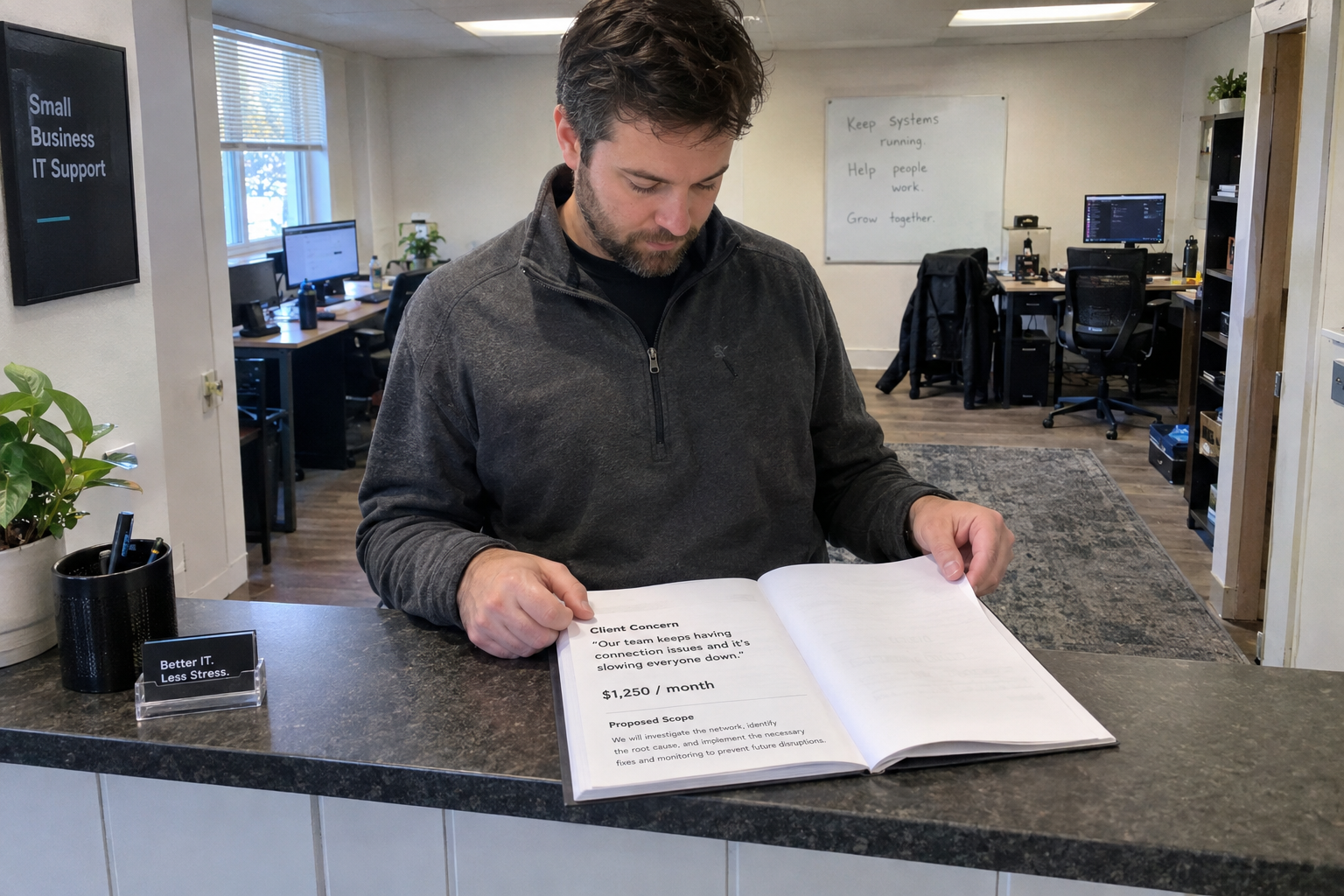
Once the client sees their problem, the price should sit right below it, in the same font size as the problem statement. A single line item, not a table of add-ons. Under it, one paragraph that says what that price covers.
My view: never email a price sheet alone. Always attach the full proposal, with the price line followed by a "what this covers" note that ties back to the problem you just named. Something like: "$2,400/month covers the problem we just described: 24/7 monitoring, backup verification, and a response time you can call."
That paragraph is what stops the "can you do 20% off?" response. It gives the price a job. The client sees what they're paying for, and it's the thing they told you keeps them up at night. A bare number invites negotiation; a number attached to a problem invites acceptance.
Ask for the Signature on the Call, Not in the Follow-Up Email
A proposal read alone rarely converts. A call with a clear ask does. So on the review call, after you walk through the problem statement and the price, ask directly: "Are you ready to sign today?"
If they hesitate, don't retreat. Say: "I understand. What part of the proposal would you like to revisit?" That keeps the conversation open and makes the next step specific. If they ask for a discount, hold the line: "The price is the price for this scope. If you need a different scope, I can re-quote."
This only works if the decision maker is on the call. If the person you're talking to has to check with a partner, the close can't happen live. That's a stated assumption, not a given. If they're not the decision maker, your job is to get the decision maker on the next call, not to close the one in front of you.
When This Structure Won't Work
This structure assumes three things: a defined scope, a decision maker on the call, and your own confidence in the price. When any of those is missing, the approach breaks.
If the scope is vague, the "what this covers" note goes hazy, and the price looks arbitrary. My recommendation: present a range with a caveat that final pricing follows a detailed scoping meeting. A client who asks for a firewall replacement without a clear project scope isn't ready for a fixed price. Schedule the site audit first.
If the client is a serial discount-seeker who pushes on every purchase, holding the price may lose the deal. That's a real cost. In that case, offer a scope reduction instead of a price cut, with a revised proposal. You keep your margin, and the client learns that your price isn't a starting point.
And if you don't believe the price is fair, none of this works. The structure collapses the moment you waver. So before you send anything, be sure you can say out loud why the price is what it is.
Start Monday: Draft Your Problem Statement From Last Week's Call
Before any new proposal goes out, write the one-page problem statement for the most recent discovery call you have. Pull up your notes from last week's call with the client who said "we're worried about ransomware." Turn that into the opening sentence of your next proposal.
That's the whole proof-of-work step. One page, their words, no company story. Do it today, and you'll see the difference in how the proposal gets received. The price is far more likely to hold, because you gave it a job.

mspoutpost.com/articles/a-proposal-that-gets-read-and-a-price-that-holds
Written by Natalie Brandt
MSP Outpost publishes information, not legal, financial, insurance, tax or compliance advice, and reading it creates no professional relationship. For decisions about your business, talk to a qualified professional.