
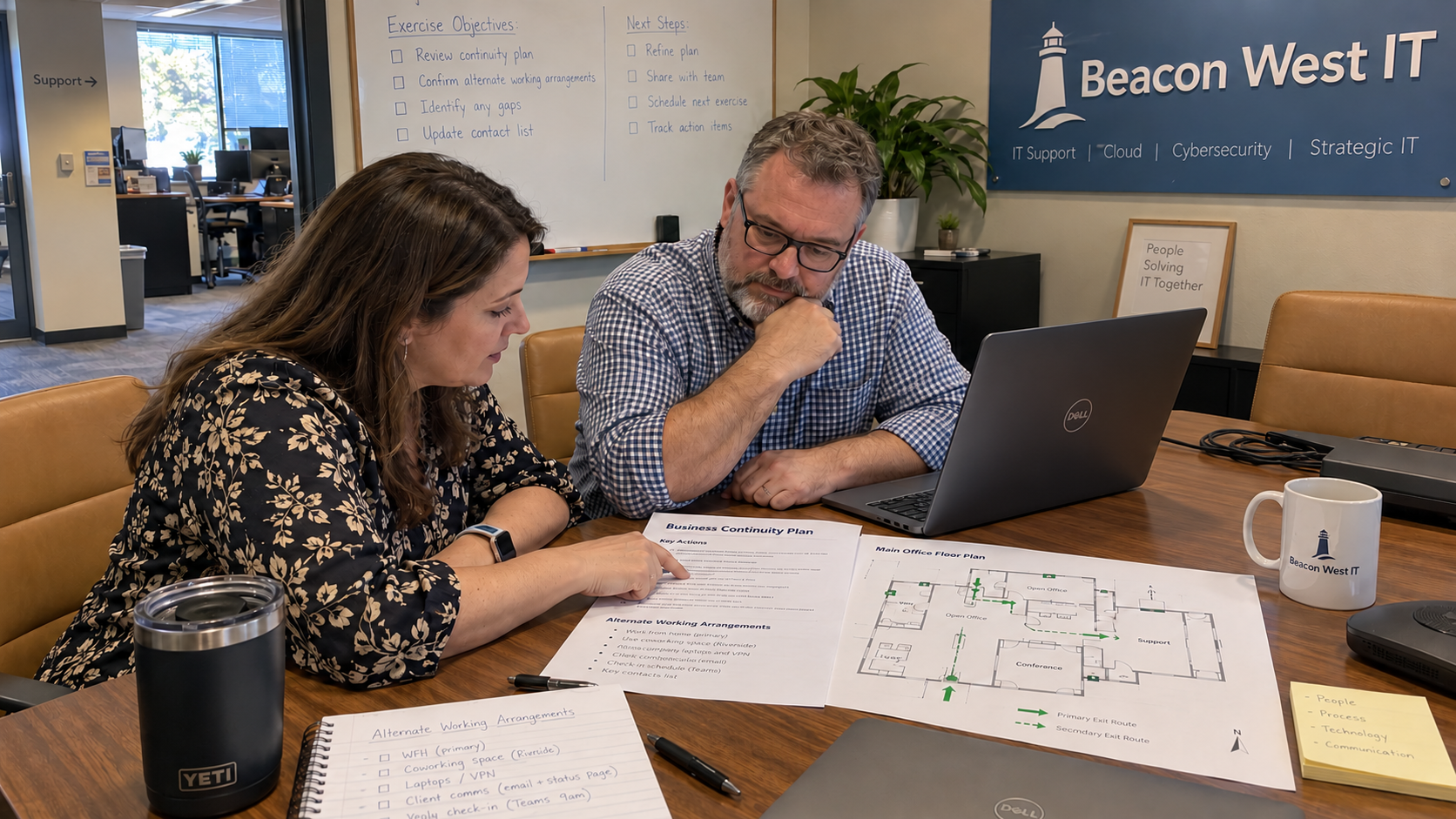
If a backup pitch promises business continuity, test it against an office staff can't enter. Your business continuity plan template must explain how the business will operate there, not just how the MSP restores data. I'd start with five decision pages linked to the detailed procedures. The client owns the operating choices; the MSP supplies the recovery work it has agreed to deliver.
Five pages is my proposed format, not a compliance requirement or a limit on necessary detail. Treat the short plan as a route map that points people to the instructions they need. It can't replace those instructions, and a completed document doesn't establish that people can carry them out.
Page One: Decide Who Acts and What Comes First
Name the client's continuity lead and deputy. Record who can activate the plan and who decides when ordinary operations can resume. Check how those decisions reach the people expected to act.
Have the business owner choose a critical process and explain the consequence of losing it. Record the approved recovery requirement with the person responsible for that process. Don't let the easiest system restore set the business priority.
Keep the supporting impact assessment with the plan. A request to restore everything urgently doesn't tell the technical team what order matters to the business. Where the client hasn't made that decision, give the unanswered question to its business owner.
Nick and Jeni Clift distinguish incident leadership from technical remediation and communication, while also keeping ordinary operations running. That's their practitioner role advice. Use the distinction to avoid assigning every business decision to the engineer already handling the technical recovery.
Page Two: Establish Where People Can Work
Record a viable alternative when the normal premises can't be used. Have the responsible manager confirm the option is available for the actual work. Working from home is a proposal to check, rather than a completed continuity strategy.
Confirm the necessary equipment and approved service access at that location. Check whether the responsible staff can perform the critical process there. A backup console is an optimistic place to look for an alternate office.
Rich Freeman recommends discussing lost office access and staff communication alongside data recovery. Keep that as his continuity-planning suggestion. Test those choices with the client instead of assuming that a successful restore supplies somewhere for people to work.
Name the manager who checks staff availability and gives operating instructions. Provide an agreed alternative when the usual communication channel isn't available. Keep the client's emergency response procedures accessible separately; this operating plan doesn't replace them.
Page Three: Connect the Process to a Tested Service
Identify the systems the chosen process needs and point to their recovery procedures. Put the business requirement beside the current tested capability. They need separate entries because approving a target doesn't make the team able to meet it.
It depends on the process deadline and on whether the available workaround lets staff perform the required work. Have the process owner define what usable means. A restored application can still fail that check if the staff who need it can't sign in.
Record who verifies the business result after technical recovery. Give them a check they can perform, with the evidence kept against the exercise or incident record. The engineer's confirmation that a system started shouldn't silently stand in for that decision.
If the tested capability falls short, name the gap and the person who decides the next action. The answer could require technical work or a different operating arrangement. Don't erase the difference by copying the requested target into the capability field.
Where a temporary manual process is viable, have its business owner approve it. Record where the temporary work is kept and who reconciles it when the application returns. Staff need a defined return path rather than another unresolved collection of records.
Page Four: Find the Suppliers the Process Needs
Record the supplier supporting the critical process and the client's authorized contact. Keep the service reference needed to request help. Check that the support route works for the actual agreement rather than saving only a general website address.
Ask the process owner what happens if that supplier can't deliver. If an alternative exists, confirm what it provides and how the client activates it. Leave the dependency explicitly unresolved if no practical alternative has been established.
Keep the MSP's coordination role aligned with its agreement. Having a supplier contact doesn't authorize the engineer to commit the client to a replacement purchase. Name who makes that decision and how the technical team obtains an answer.
Check the supporting dependencies before describing an alternative as ready. A different work location may still rely on the same unavailable service. Give the responsible person the actual constraint to resolve.
Page Five: Exercise the Decisions and Keep Them Current
Name the plan owner and identify the approved version. Agree the next review date with the client. Set an additional review trigger when a relevant dependency or responsible person changes.
I'd exercise a scenario that challenges a real assumption in the plan. Ask the people responsible to find their instructions and explain the next action. Record the gap when they can't, then give the correction a named owner and an agreed follow-up date.
Picture an exercise in which the plan lives only in the application the scenario makes unavailable. The continuity lead could discover that failure before the recovery engineer begins work. Check an appropriate alternative access route while keeping the plan's sensitive information protected.
Use the result to correct the operating choice or the supporting procedure. Keep unresolved work visible with the approved version so nobody mistakes a known gap for a verified capability. Recheck the affected assumption after the correction.
Agree What the MSP Has Actually Promised
Review the draft with the client's business owner and the people expected to use it. Have them approve the operating decisions and confirm which technical work belongs to the MSP. A planning meeting shouldn't quietly create a recovery commitment the service team hasn't accepted.
The model includes baseline security in every managed plan. Check that coverage when considering a temporary working arrangement. Disruption doesn't settle whether the proposed alternative meets the agreed controls.
Ask the client to choose a critical process, then complete the relevant decisions with its owner. Exercise a scenario that could stop that process. Save the approved plan with its review date and the assigned corrections so the next person can see what is ready and what still needs work.

mspoutpost.com/articles/business-continuity-plan-template-five-useful-client-pages
Written by Dana Kowalski
MSP Outpost publishes information, not legal, financial, insurance, tax or compliance advice, and reading it creates no professional relationship. For decisions about your business, talk to a qualified professional.