
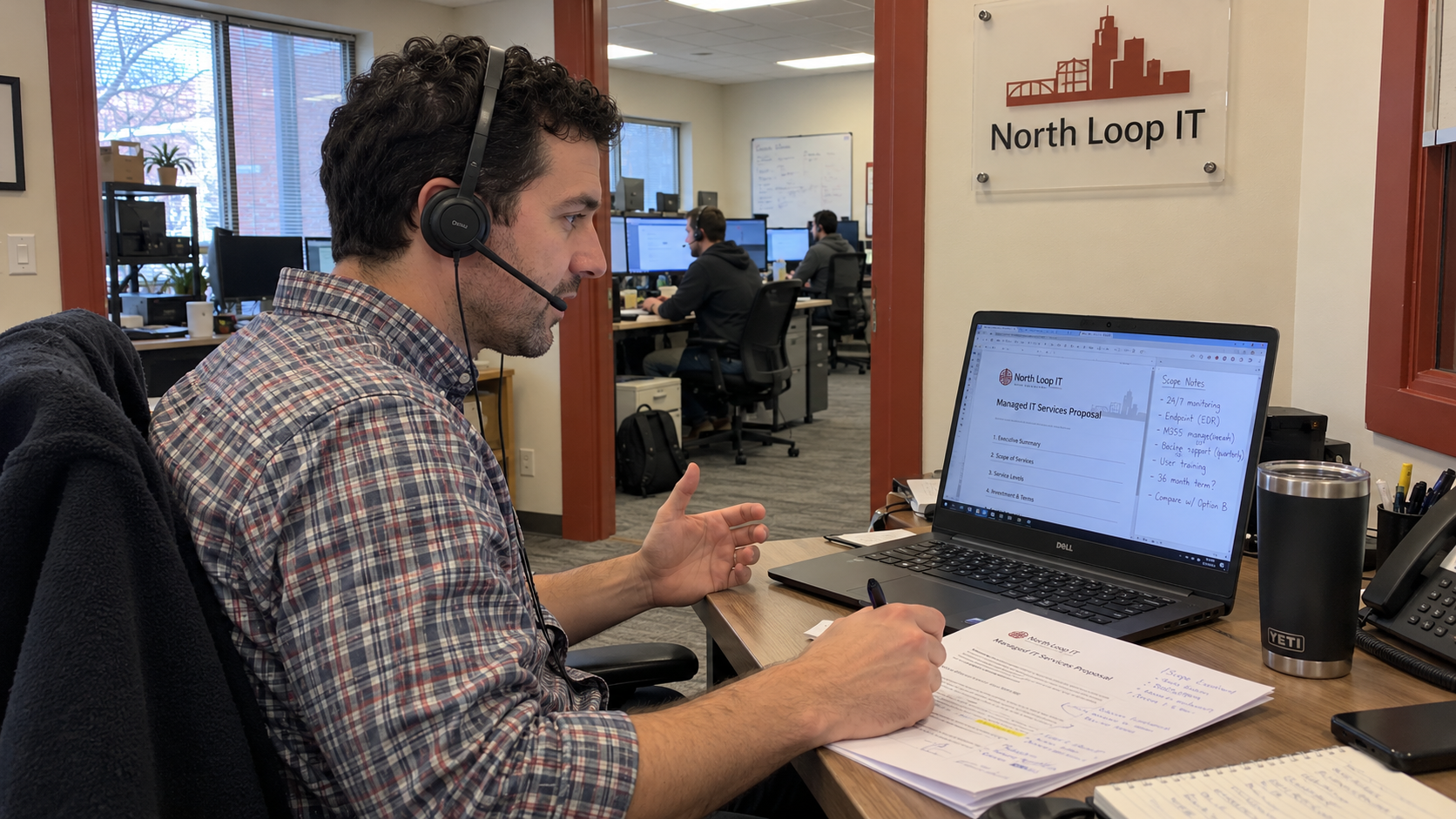
"It's too expensive." When handling price objections, I'd ask: "What are you comparing it with, and which part feels out of reach?" Then let the prospect explain before you change the proposal. A budget limit and a different service quote need different replies.
I don't buy generic sales advice that starts with splitting the price difference. An MSP is agreeing to carry ongoing responsibilities at that recurring rate. Establish what the buyer needs, explain the costed scope, and keep the monthly price intact.
Make the Price and Scope Concrete
Say you quote the model's US example fee of $225 per seat for a hypothetical 20-seat client. That is $4,500 a month, calculated as 20 multiplied by $225. Show what the agreement includes and what remains separately priced, so the buyer can compare a defined service rather than an unexplained total.
The model's $150 seat floor is a danger line, not a suggested counteroffer. A fee above it still needs a delivery-cost check. The sales conversation should use the price your scoped service requires instead of treating the floor as room to negotiate.
You can say: "This monthly fee covers the responsibilities listed here. These items remain separate. Before we change anything, let's check whether this is the service you need." Have the actual scope open when you say it.
When They Mean the Monthly Budget
If the buyer says the monthly amount is outside their budget, ask: "Which responsibilities do you need us to take on, and what budget have you set aside for them?" Record both answers. You need delivery to assess any different scope before offering a different service.
Then say: "I can have a narrower scope reviewed and priced if some responsibilities belong elsewhere. I can't promise the same service at a lower monthly rate." Bring back the changed responsibilities in writing, with the receiving owner identified where the client retains work.
Keep baseline security in the managed plan. The model includes endpoint protection, MFA, awareness training, and email protection in every plan, with advanced tools as add-ons. Don't make the headline cheaper by quietly removing the baseline the team expects to deliver.
If a supportable offer remains outside the buyer's budget, say that plainly. An account you can't deliver at the agreed price needs a commercial decision, rather than another round of language designed to make the same fee feel smaller.
When Another MSP Quoted Less
Start with: "Can we compare the responsibilities in both proposals? I want you to see what each monthly fee covers." Ask permission to review the competing scope. Don't claim the other MSP has omitted security, support, or account work without reading the offer.
Compare the same units and service boundaries. Check the billed users or devices, included hours, ongoing responsibilities, separately charged work, and transition requirements. Identify unknowns as questions for the buyer to settle rather than filling them with assumptions about the competitor.
If the difference is real, say: "Their proposal includes this responsibility differently. Here is how ours handles it and what that means for your team." Use a concrete scope difference, then ask whether that responsibility matters to the decision.
When you can't establish a difference yet, what should you say? Try: "I need to check that point before I compare the offers. I'll confirm what our team can deliver and come back with a clear answer." Give that follow-up a named owner rather than improvising a superiority claim.
If the competing scope genuinely matches, review your own costed offer and fit. A comparison can reveal work to improve in your delivery model. It doesn't oblige you to match a recurring price you haven't shown you can support.
When They Already Have Someone
Treat that as information. Ask: "What prompted you to look at another option if you already have support?" The answer tells you whether there is an unmet need, a future review, or simply no reason for a new proposal now.
If they are satisfied, say: "It sounds as though you have what you need. Is there an agreed time when you review that arrangement, or would you prefer that we leave it here?" Record their preference. Don't invent dissatisfaction or an urgent replacement case.
If they name a gap, say: "Let's define that gap before discussing a switch. What needs handling differently, and who owns it today?" Keep the discovery focused on the buyer's actual requirement. A complaint about a response does not establish that your standard plan solves the underlying problem.
You may be considering a separate project or a co-managed responsibility rather than a full replacement. Have the relevant delivery owner assess that scope. Don't use a small unresolved issue as permission to promise a service your team hasn't costed.
When the Cost of Moving Is the Objection
Separate transition cost from recurring price. Ask: "Is the difficulty the monthly service, or the work and expense of moving over?" If it is the transition, explain the actual onboarding scope and the responsibilities the client needs to complete.
The model's usual concession is quoted onboarding waived for the signed agreement. The work remains unpaid project-engineer labor in its delivery plan. Check the actual scope and capacity before offering it, particularly where a larger remediation or migration is separate.
A clear reply is: "We can include the quoted onboarding work with the agreement. The monthly service remains at the proposed rate. These separately scoped changes would still need approval." Show the quoted work and its boundaries so the concession has a definite meaning.
Finish With an Agreed Next Step
After the response, ask: "Does that resolve the point you raised, or is there another part we need to work through?" Listen for the remaining condition. A polite acknowledgment isn't the same as agreement on the scope, price, and decision process.
Record the actual objection, the answer given, the unresolved question, and who owns the next action. Put the expected decision date beside the evidence supporting it. Keep an unknown date unknown until you have something firmer than the seller's preference.
Practice the replies against your real offer before the proposal call. Have delivery check the scope explanations and finance check any proposed concession. I'd give the seller words they can use confidently because the work behind those words has been agreed.

mspoutpost.com/articles/handling-price-objections-without-cutting-msp-rates
Written by Natalie Brandt
MSP Outpost publishes information, not legal, financial, insurance, tax or compliance advice, and reading it creates no professional relationship. For decisions about your business, talk to a qualified professional.