
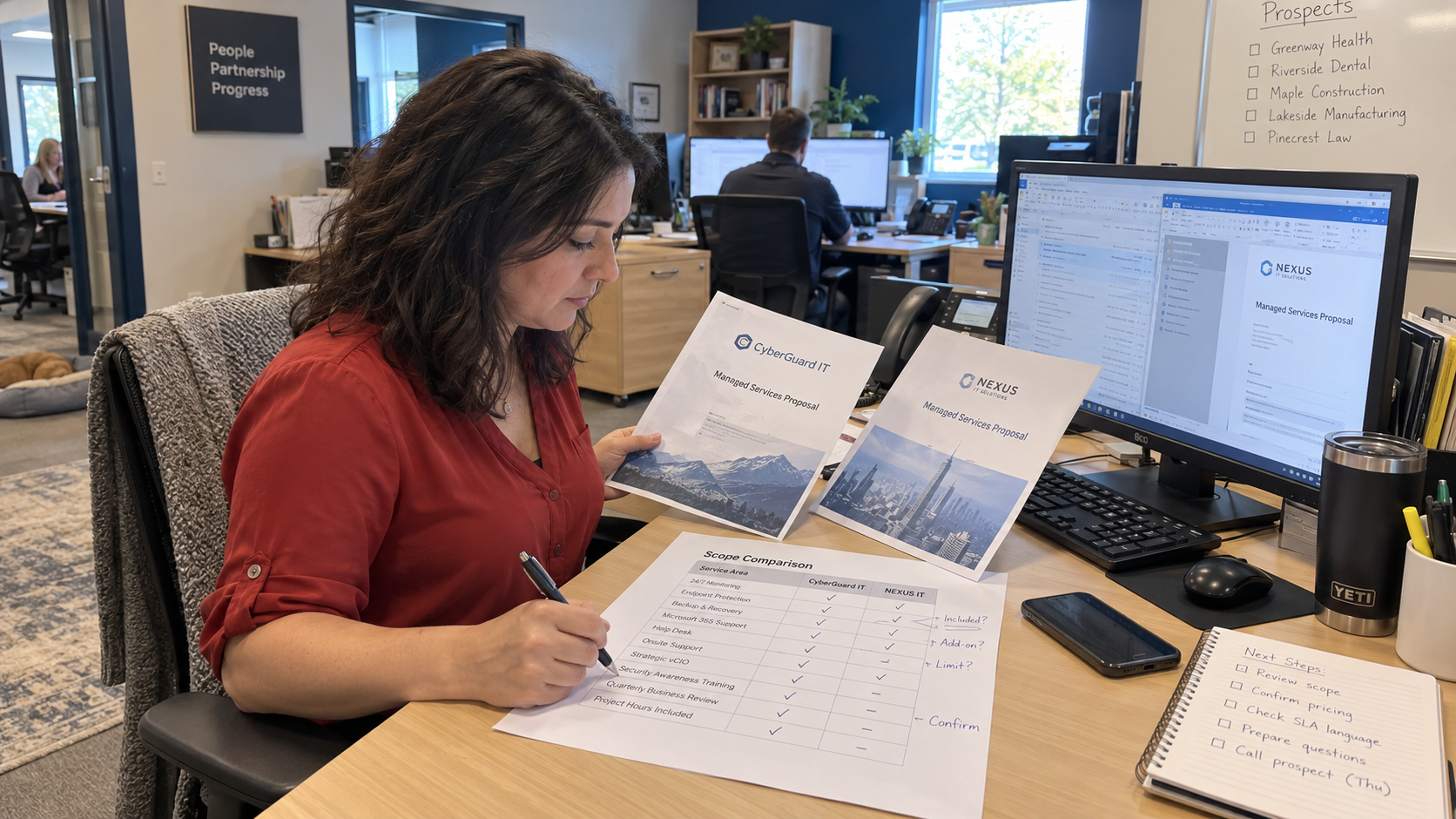
Deciding how to compete with low price competitors starts with your scope and delivery cost. Check what the prospect is comparing, explain the difference, and keep the recurring fee you need to deliver the approved service. A lower competing quote doesn't establish that the other MSP is losing money.
I'd stay in the conversation when the prospect will discuss the work and its price. If the required service only sells after you break your own pricing rules, let the deal go. Don't turn the monthly fee into an amount you hope to repair after signing.
Find Out What the Prospect Is Comparing
Start with this: Can we put the services and monthly totals beside each other? I want you to see which work each fee covers before deciding whether the difference matters.
Confirm the seat definition, supported systems, service hours, exclusions, baseline security, and separately charged products or projects. Use the competing proposal the prospect is authorized to share. Don't fill missing terms with an assumption that makes your own offer look better.
If an item is unclear, say: I can't tell from this proposal whether that work is included. Let's confirm it rather than assume you'll pay extra or receive less.
Keep the total monthly amount in the conversation. On a podcast, Brian Hoppe recommends checking a prospect's budget against a total monthly range, while keeping internal per-user economics separate. That's his presentation preference. It lets you discuss the actual bill without asking the prospect to assemble it from unit prices.
Know the Cost Before You Defend the Fee
The model's US seat-price goal is $225 and its floor is $150. The floor is a danger line, not a price you should aim to match. The managed-services gross-margin target is 50%, after burdened delivery labor and tools.
For a limited worked example, use the model's 20-seat client and $103.10 monthly delivery cost per seat. That cost comes from the well-run example at 0.5 tickets per seat a month; a typical MSP runs 1.0 to 1.4. Hold the scope and modeled cost unchanged for this price comparison.
For this example at $225, calculate the monthly fee as 20 × $225 and delivery cost as 20 × $103.10. Subtract delivery cost from the fee for gross profit, then divide gross profit by the fee to find the managed-services gross margin.
Repeat that calculation at the $150 floor, keeping the same assumed 20 seats and $103.10 delivery cost per seat. Compare the gross-profit amounts: the monthly difference is 20 × ($225 − $150). Sales, overhead, and the owner's fair-market salary still need funding after delivery costs.
That calculation describes your modeled offer under fixed assumptions. It says nothing about the competitor's costs. They may have different scope, operating costs, or a different commercial arrangement. Ask about the comparison without pretending to know their profit.
Explain the Work the Fee Funds
Use the scope you've actually approved with the service lead. Show how support, account work, and the baseline are delivered, with the relevant responsibilities and exclusions. Don't substitute claims about better service for something the prospect can inspect.
You can say: Our monthly fee funds the work in this scope. Here is who handles requests, how we manage the standard environment, and which projects are quoted separately. Tell me which part doesn't match what you need.
The model includes endpoint protection, MFA, awareness training, and email protection in every plan. Keep that baseline in the offer. Don't remove it as a price concession while describing the result as the same managed service.
My objection to match-the-sticker-price advice is the ongoing delivery commitment. An MSP fee pays for work that continues after the sale. Compare what you can sustainably deliver before treating a lower price as a closing technique.
Give the Price Objection a Clear Reply
If the prospect says the other proposal is cheaper, use this reply: Yes, the monthly total is lower. We've checked the scope we can verify. Our fee is the price for delivering this agreed service. Which requirement would you want changed before deciding?
If they ask for the same scope at a lower recurring price, say: We won't reduce the monthly fee for the same service. We can check whether a different, supportable scope fits your need, but we'll cost that work before quoting it.
The model doesn't discount MRR to win a client. It puts concessions on a bonus item, usually quoted-then-waived onboarding for a signed agreement. Any concession still needs approval, a defined scope, and a funded delivery plan.
You can offer: We can include the quoted onboarding as the agreed one-time concession. The recurring service fee stays as shown. That makes the concession visible without creating a lower monthly price the business must carry.
Change Scope Only When It Still Fits the Service
A prospect may genuinely need a different arrangement. Review the request with the service lead and confirm who will own the excluded work. Write down the boundary so it doesn't return to the desk as an unpriced expectation.
Cost the revised delivery work and products before showing a new fee. Keep the price floor and baseline requirements in the decision. Removing a line from a proposal doesn't establish that the team will spend less time on the client.
Have the prospect confirm the changed scope in plain words. Then ask the delivery owner to accept it. The sales conversation isn't complete while each side is describing a different service.
Walk Away Without Inventing a Story About the Buyer
If the prospect won't fund the service you can offer, give a clear closing answer: We can't provide that scope at the budget you've set. If the requirements or budget change, we're happy to review them with you.
Don't call the prospect a bad client because they choose the cheaper quote. Don't tell them the competitor will fail. You have a decision about the work your own business is prepared to accept, not evidence about what will happen elsewhere.
The model calls for grading clients on margin and fit. Apply that discipline before signing too. A deal that adds recurring revenue still needs a delivery case you can explain.
- The salesperson confirms the comparison scope and total fee with the prospect.
- The service lead accepts the proposed work and checks the delivery assumptions.
- Finance checks the cost, margin, floor, and any approved concession.
- The owner approves an unusual scope decision before it becomes a commitment.
- The salesperson records the decision and the prospect's stated reason in the CRM, without guessing their motives.
Take the next low-price objection to the comparison sheet and cost calculation. Keep selling while there is a service the prospect needs and your team can fund. If that combination isn't there, close the conversation plainly and spend the next selling effort on a fit you can deliver.

mspoutpost.com/articles/how-to-compete-with-low-price-competitors-as-an-msp
Written by Natalie Brandt
MSP Outpost publishes information, not legal, financial, insurance, tax or compliance advice, and reading it creates no professional relationship. For decisions about your business, talk to a qualified professional.