
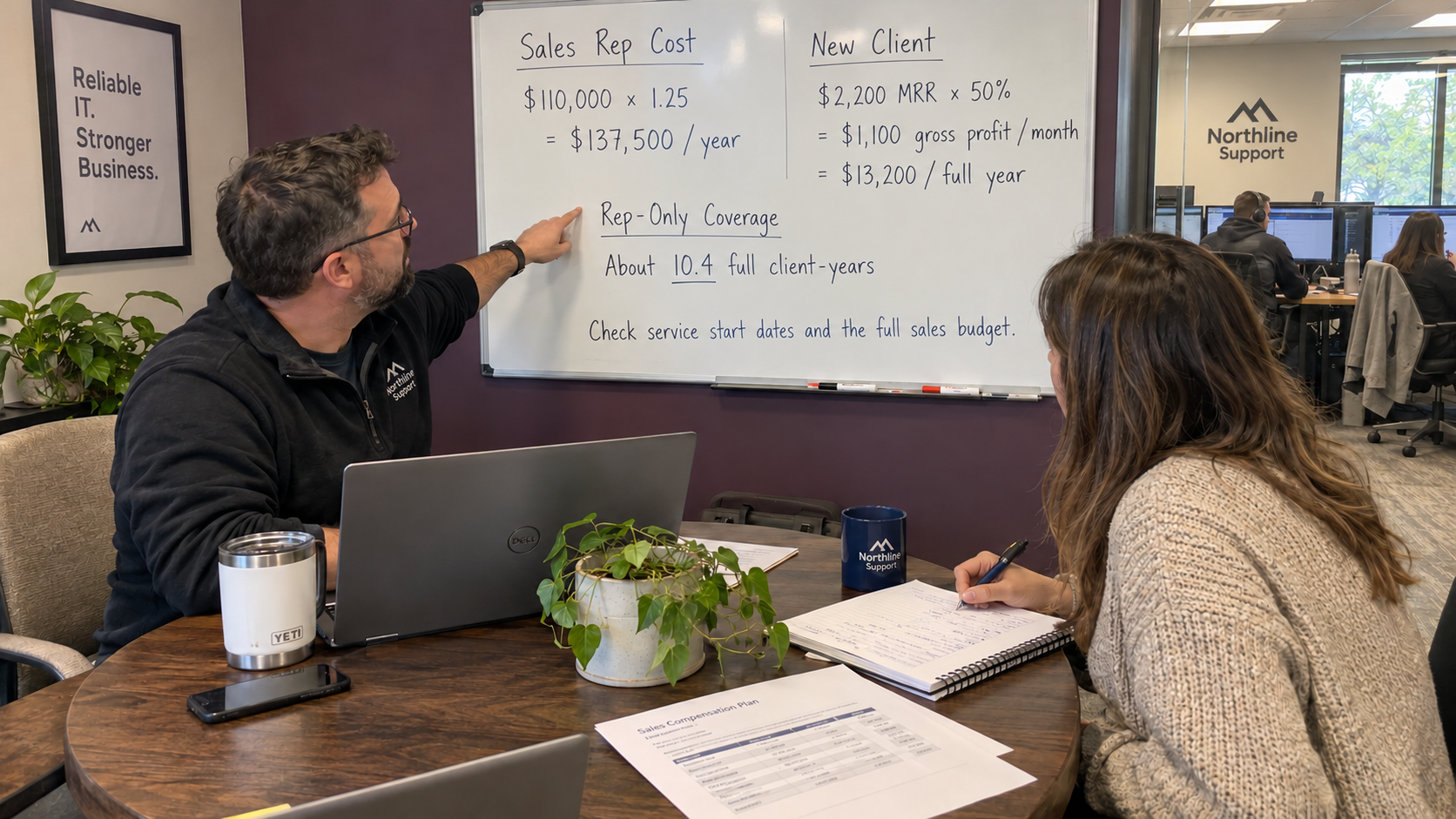
Before you agree an MSP sales rep quota, say: 'At the model's starting fee and margin, it takes about 10.4 full client-years to cover your role alone. Let's turn that into a funded quota using the dates clients will actually start.' That gives you a number to work from and a funding question to answer before hiring.
A full client-year is a year of contribution from a client at the assumed fee and margin. Winning a contract partway through your budget year doesn't produce a full year's contribution in that period. Keep the annualized calculation beside a forecast of when the work starts and the money arrives.
Price the Pay Plan Before the Quota
On-target earnings, or OTE, means base pay plus commission at the intended performance level. The MSP model's US sales rep has $110,000 of OTE. Apply its general employee burden multiplier: $110,000 times 1.25 equals $137,500 of annual people cost.
Use that loaded cost when checking what the hire must fund. The owner's lower burden is a separate assumption; it isn't the multiplier for this employee. Ask finance to cost the actual compensation plan, including what it pays when the rep performs above or below target.
Start the conversation plainly: 'We're budgeting the pay you earn at target, not just your base salary. Before we agree the target, we'll show you the contribution calculation and the opportunity budget behind it.' You can then discuss the job without pretending the commission component is free.
Calculate the Client Profit Needed
The model starts a new client at $2,200 of monthly recurring revenue, or MRR. Its installed example averages $4,500 per client each month. Use the new-client input for this calculation rather than assuming every new signing arrives at the installed average.
Assume the starting fee stays constant and earns the model's 50% managed-service gross margin. That margin includes burdened delivery labor and tools. Gross profit is the fee left after those direct delivery costs, and it still has to pay for sales and overhead.
| Calculation | Named Inputs and Working | Result |
|---|---|---|
| Monthly contribution per client | $2,200 MRR × 50% gross margin | $1,100 per month |
| Contribution for a full client-year | $1,100 per month × 12 months | $13,200 per year |
| Rep-only annual cost coverage | $137,500 loaded annual pay ÷ $13,200 per full client-year | About 10.4 full client-years |
The division is $137,500 divided by $13,200, or about 10.4. It covers the rep's modeled annual pay alone. Put the rest of the sales budget and the overhead still to be funded beside it before treating the result as an affordable hiring plan.
Ask the service lead to check whether the proposed client scope can earn the margin used in the calculation. A signed fee doesn't establish its delivery cost. If the scope needs more effort than you allowed, recalculate the contribution before giving it full credit toward the target.
Put Service Start Dates Beside Every Win
What should you ask when a quota is presented as a client count? Say: 'Show me when those clients start paying and how much gross profit falls inside this budget year.' That is the next calculation to review with the sales candidate and finance.
For each expected start, multiply monthly gross profit by the months of service remaining in your planning period. Add those contributions and compare them with the rep cost for that same period. Keep the full annualized contribution in a separate column so it can't be mistaken for current-year coverage.
Use your own hiring and sales records to plan when the rep could produce those starts. Include the preparation and pipeline work the role needs; don't assume the hire inherits qualified opportunities unless that is part of your plan. The model provides no universal ramp schedule.
Then put receipts and payments into the cash forecast. A service start, invoice date, and collection date describe different events. The contribution forecast helps you assess the economics, while the cash forecast tests how you will pay the rep before collections cover the commitment.
Check Whether the Whole Sales Budget Fits
The model's stable US sales-and-marketing budget is $218,077, or 6% of revenue. It already includes the $137,500 rep, leaving $80,577 for programs. Don't add the rep to the full budget again.
Customer acquisition cost, or CAC, is total sales-and-marketing spending divided by new clients won. At the model's assumed $25,000 CAC, $218,077 divided by $25,000 produces about 8.7 new clients annually. That is a planning average under the model's assumptions, not a guarantee from spending the budget.
Even if those 8.7 wins each contributed a full year at the starting fee and margin, they would fall below the rep-only coverage point of about 10.4 full client-years. Start dates can reduce the contribution recognized in the hiring year further. Identify the funding or changed assumptions before you approve the job.
You can say: 'The stable budget models about 8.7 wins, while your role alone needs about 10.4 full client-years at these inputs. We need to show how the wider plan funds that gap before calling the quota affordable.' That is a conversation about the plan you are offering, not an accusation about a candidate's ability.
Write the Terms the Rep Can Inspect
My view is that generic advice to book more demos skips the MSP's delivery economics. A meeting count cannot pay a salary, and a high recurring fee can still carry expensive work. Give the rep a target tied to the contribution the MSP needs and a clear definition of what gets credited.
Settle the following points in the forecast and compensation plan before making an offer. Use the same definitions when you review the pipeline.
- Owner and finance: record the new recurring fee and contribution the plan requires, alongside the budget that funds the role.
- Sales lead: define when a deal counts and how service start dates affect credit in the planning period.
- Service lead: confirm the accepted scope and delivery assumptions before a signing receives its planned margin credit.
- Owner: state commission eligibility and payment conditions, including how your plan treats collections and client departures.
- Sales lead: name who supplies and qualifies opportunities, with the program spending available for that work.
Give the candidate an exact question they can answer: 'Can you see which deals earn pay, how the amount is calculated, and where the underlying results will be recorded?' Resolve an unclear answer before asking them to sign. Have the appropriate adviser review the written employment and compensation terms.
Keep Hunting Capacity in the Plan
The model separates new-business hunting from account management. It places technical alignment manager and vCIO work in delivery labor. If you also assign existing-account work to the rep, cost that role and revisit the time available to win new business.
Track the starting fee and service date for each win in the sales forecast, then reconcile its contribution with delivery costs. If fees, margin, or start dates differ from the plan, revise the remaining funding requirement. Don't preserve a quota calculation by leaving its inputs unchanged after the business has changed.
Before you recruit, finish the client-year calculation with your own costs and put expected starts beside it. Agree the total budget with finance and the scope with the service lead. Then give the candidate the quota, the opportunity support, and the payment rules as one funded proposal.

mspoutpost.com/articles/msp-sales-rep-quota-what-covers-the-cost-of-the-hire
Written by Natalie Brandt
MSP Outpost publishes information, not legal, financial, insurance, tax or compliance advice, and reading it creates no professional relationship. For decisions about your business, talk to a qualified professional.